Learning how to start saving money can feel difficult when there never seems to be much left at the end of the month.
Bills need to be paid. Groceries cost more than expected. Small purchases add up. Then an unexpected expense appears, and saving gets pushed to next month again.
The good news is that you do not need a large income or a perfect budget to begin.
If you want to learn how to save money, start with one simple goal, choose an amount you can realistically save, and create a system you can repeat.
You do not have to change your entire life.
You just need to start.
Pretty Savings Studio
Pretty tools for your more beautiful and organized life:
1. Choose One Reason to Save Money
Saving is easier when your money has a clear purpose.
“Save more money” is too vague.
Instead, choose something specific.
For example:
- build a $1,000 emergency fund;
- save for a vacation;
- buy a new car;
- prepare for Christmas;
- save for a wedding;
- buy a new phone or laptop;
- save for furniture or home improvements;
- build a down payment for a home;
- save for a special purchase.
A clear savings goal gives you a reason to keep going.
Instead of saying:
I want to save money.
Say:
I want to save $1,500 for a vacation.
Now you have something you can measure.
2. Start With One Savings Goal
You may have several things you want to save for.
That is normal.
But if you are just starting, trying to save for five or ten goals at the same time can feel frustrating.
Your money gets divided into small amounts, and progress feels slow.
Choose one priority first.
Ask yourself:
What do I want or need most right now?
It might be an emergency fund.
It might be a vacation.
It might be money for Christmas.
Once you begin making progress, you can add another goal.
This makes saving money feel simpler and more manageable.
3. Look at Where Your Money Goes
You do not need a complicated budget to start.
Simply review your recent spending.
Look at your bank account or credit card statements and notice where your money went during the last month.
Pay attention to:
- groceries;
- eating out;
- coffee and snacks;
- subscriptions;
- clothing;
- beauty products;
- entertainment;
- transportation;
- online shopping;
- small everyday purchases.
You may find several expenses you barely notice.
The goal is not to stop enjoying your life.
The goal is to find money that could be used for something more important to you.
Even $20 or $30 redirected each month can become the beginning of a real savings plan.
4. Decide How Much You Can Save
One of the easiest ways to fail at saving is to choose an unrealistic amount.
You may want to save $500 every month.
But if your current budget only allows $75, saving $500 is not a useful plan.
Start with an amount you can repeat.
That might be:
- $5 a week;
- $20 per paycheck;
- $50 a month;
- $100 a month;
- 5% of your income.
There is no perfect starting amount.
The important thing is consistency.
Saving $50 every month is better than planning to save $500 and giving up after the first month.
You can always increase the amount later.
5. Break Your Goal Into Smaller Amounts
A large number can feel overwhelming.
Breaking it into smaller steps makes it easier.
Use this simple formula:
Savings goal ÷ number of months = monthly savings amount
For example, imagine you want to save $1,200 in one year.
$1,200 ÷ 12 = $100 per month
If you are paid twice a month, that becomes:
$100 ÷ 2 = $50 per paycheck
Now the goal feels much more realistic.
Instead of thinking:
I need $1,200.
You can think:
I need to save $50 from each paycheck.
That is the basis of a simple money saving plan.
6. Save First, Spend Second
Many people try to save whatever is left at the end of the month.
The problem is that often there is nothing left.
Try reversing the order.
When you receive money, move your planned savings amount first.
For example:
Paycheck arrives → $50 goes into savings → the rest is available for expenses.
This is often called paying yourself first.
The amount does not need to be large.
What matters is creating the habit.
If possible, set up an automatic transfer so you do not have to remember every month.
Even a small automatic transfer can make saving much easier.
7. Keep Savings Separate
If all your money stays in one account, it can be difficult to know what is available to spend and what should remain untouched.
Keeping savings separate can help.
You might use:
- a separate savings account;
- different savings categories in your banking app;
- sinking funds;
- cash envelopes for suitable short-term goals.
The idea is simple:
Money for your savings goal should feel different from everyday spending money.
If you are saving for a vacation, that money is not extra money for online shopping.
If you are building an emergency fund, it is not money for a spontaneous weekend away.
Giving savings a clear purpose can make it easier to protect them.
8. Find Small Expenses to Reduce
You do not have to stop buying everything you enjoy.
Instead, look for spending that does not matter very much to you.
For example, you might:
- cancel one subscription you rarely use;
- eat at home one extra time each week;
- reduce impulse shopping;
- plan grocery purchases before going to the store;
- wait before buying nonessential items;
- use products you already own;
- have several no-spend days each month.
The important part comes next.
When you save money on something, move that money toward your goal.
If you cancel a $15 subscription but simply spend that $15 somewhere else, your savings do not grow.
Instead:
Subscription canceled → $15 moved to savings.
Small changes can add up surprisingly quickly.
9. Use a Savings Tracker
A savings tracker can make your progress much easier to see.
This is especially useful when your goal will take several months.
For example, imagine your goal is $1,000.
You could use a savings goal tracker divided into 50 sections.
Each section represents $20.
Every time you save another $20, you color or mark one section.
The tracker slowly fills up as your savings grow.
You can use:
- a printable savings tracker;
- a money saving tracker;
- a saving tracker;
- a savings planner;
- a spreadsheet;
- a notebook.
The method does not matter as much as being able to see your progress.
A visual money savings tracker can make a distant goal feel more real.
It also gives you a small sense of achievement every time you add money.
10. Try a Savings Challenge
If you find ordinary saving boring, a savings challenge can make it more interesting.
A challenge gives you a clear structure to follow.
Popular options include:
- 30 day savings challenge;
- 52 week savings challenge;
- weekly savings challenge;
- monthly savings challenge;
- 100 envelope challenge;
- no-spend challenge;
- fixed-amount money saving challenge.
You do not need to choose the most difficult challenge.
Choose one that fits your income and lifestyle.
A simple money saving challenge that you finish is much more useful than an ambitious challenge that you abandon.
Savings challenges can also work well for specific goals such as vacations, Christmas, a new car, or a special purchase.
What Should You Save for First?
If you currently have no savings, a small emergency fund can be a useful first goal.
Unexpected expenses happen.
A repair, medical bill, replacement appliance, or other surprise can quickly affect your budget.
Even a modest financial cushion can help.
After that, you can begin saving for other goals.
A simple order might be:
- small emergency fund;
- predictable upcoming expenses;
- short-term personal goals;
- larger long-term savings goals.
There is no single order that works for everyone.
Your priorities depend on your own life.
How Much Money Should You Save Each Month?
There is no universal amount.
The right number depends on:
- your income;
- your regular expenses;
- your financial obligations;
- your savings goals;
- your deadline.
If money is tight, start small.
For example:
$25 per month → $50 per month → $75 per month → $100 per month
You can increase your savings over time.
Starting with a manageable amount is often better than waiting until you can afford to save a lot.
How to Stay Motivated to Save Money
Saving can feel slow, especially when the goal is large.
A few simple strategies can help.
Keep your goal visible.
Track your progress.
Break one big goal into smaller milestones.
Celebrate progress without spending the money you just saved.
For example, instead of thinking only about reaching $2,000, create smaller milestones:
$250 → $500 → $1,000 → $1,500 → $2,000
Each milestone gives you a reason to keep going.
This is another reason a saving goal tracker can be useful.
You can see that you are moving forward even when the final goal is still far away.
What If You Miss a Month?
Do not quit.
Real life is not perfectly predictable.
One month you may have a higher bill.
Another month you may need a repair.
You may spend more than planned.
You may even need to use some of your savings.
That does not mean your savings plan failed.
Start again.
If you planned to save $100 but can only save $20 this month, save $20.
If you miss one month completely, continue the next month.
Progress matters more than perfection.
A Simple Plan to Start Saving Money Today
If you want to begin now, keep it simple.
Step 1: Choose one savings goal.
Step 2: Decide how much money you need.
Step 3: Choose a realistic deadline.
Step 4: Calculate how much to save each month.
Step 5: Make your first transfer.
Step 6: Track your progress.
For example:
Goal: $1,200
Purpose: Vacation
Deadline: 12 months
Monthly savings: $100
Tracking method: Printable savings goal tracker
That is enough to start.
You do not need a complicated financial system.
You need a clear goal and a simple routine.
Start Small and Keep Going
Learning how to start saving money is not about becoming perfect with money overnight.
It is about creating one small habit you can continue.
Choose a goal.
Save an amount you can afford.
Track your progress.
Adjust when necessary.
Then repeat.
Over time, small amounts can become meaningful savings.
Whether you are building an emergency fund, planning a vacation, saving for Christmas, or working toward a larger dream, the same principle applies:
Start with what you can save today.
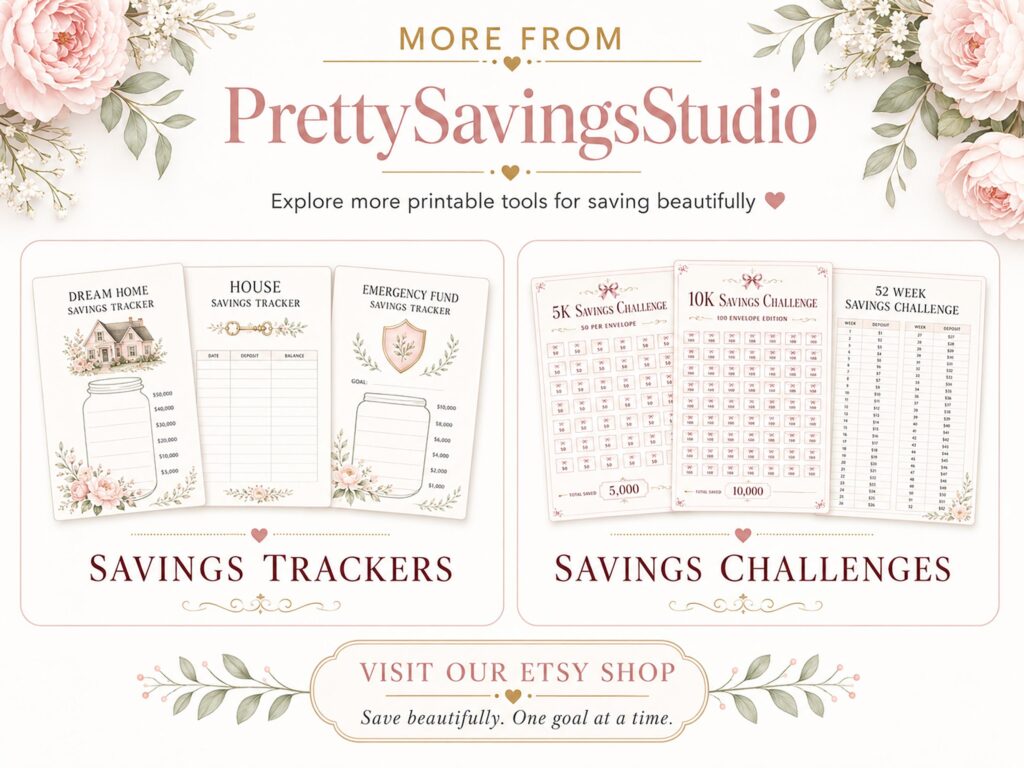
A printable savings tracker, savings planner, or money saving challenge can help you stay focused and make your progress easier to see.
Explore our savings trackers and savings challenges and choose a simple tool for your next savings goal:
Pretty Savings Studio
Pretty tools for your more beautiful and organized life: