If you need to save money fast, the best place to start is not with a complicated budget.
Start by finding money you can redirect toward one clear goal.
You may want to build an emergency fund, pay for a vacation, prepare for Christmas, buy a car, or save for a large purchase. Whatever your goal, the basic idea is the same:
Spend less on things that matter less and move that money toward something that matters more.
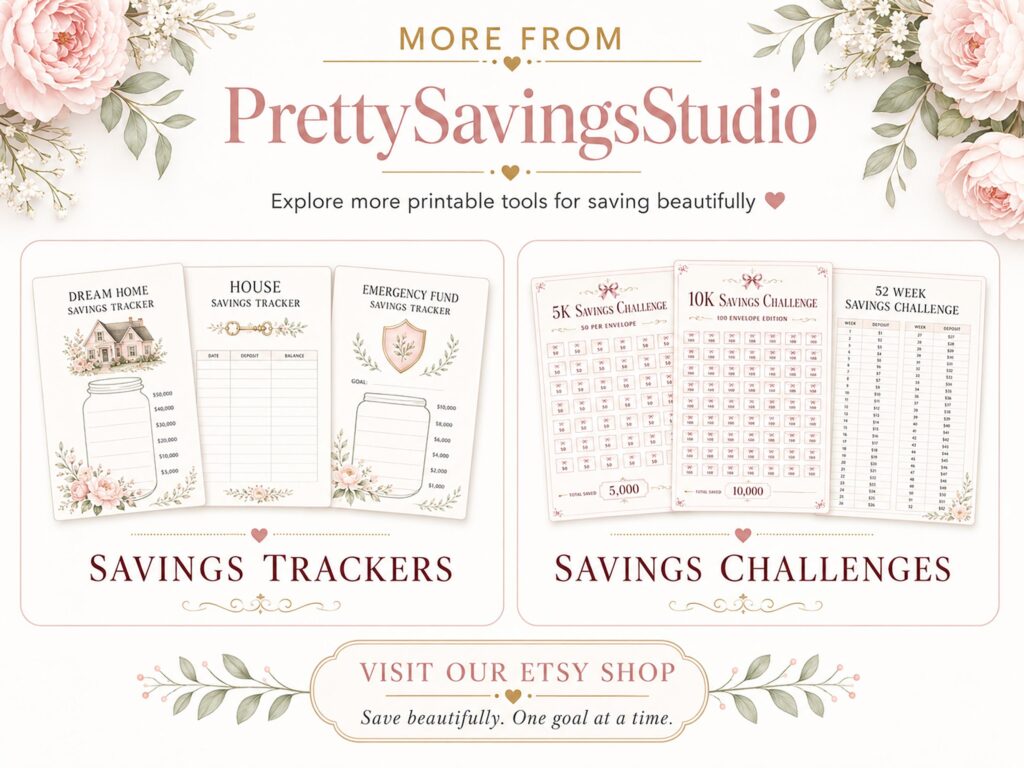
Pretty Savings Studio
Pretty tools for your more beautiful and organized life:
Learning how to save money quickly does not mean giving up everything you enjoy. It means making a few focused changes for a short period of time and tracking the results.
Here are 15 practical ways to start.
1. Set a Specific Savings Goal
It is easier to save quickly when you know exactly what you are working toward.
Instead of saying:
I need to save more money.
Choose a number.
For example:
I want to save $1,000 in five months.
Now divide the goal by the number of months:
$1,000 ÷ 5 = $200 per month
Your large goal has become a much simpler monthly target.
If you are paid twice a month, you could break it down again:
$200 ÷ 2 = $100 per paycheck
A clear target makes your savings plan easier to follow.
2. Track Your Spending for a Week
If you want to save money fast, first find out where your money is going.
For one week, write down everything you spend.
Include:
- groceries;
- coffee;
- takeout;
- transportation;
- subscriptions;
- clothing;
- beauty products;
- entertainment;
- online shopping;
- small impulse purchases.
You may be surprised by how much disappears through small expenses.
You do not have to stop all of them.
Simply look for the ones you would rather exchange for faster progress toward your savings goal.
3. Have a Temporary Low-Spend Period
One of the simplest ways to save quickly is to create a short low-spend period.
Try it for:
- one weekend;
- one week;
- two weeks;
- one month.
During that time, continue paying normal bills and buying essentials, but reduce unnecessary purchases.
You might temporarily pause:
- takeout;
- new clothes;
- beauty purchases;
- entertainment shopping;
- home decor;
- unnecessary online orders.
This does not have to become your permanent lifestyle.
Think of it as a short savings sprint.
4. Cancel Subscriptions You Do Not Use
Subscriptions are easy to forget because the payments happen automatically.
Review your:
- streaming services;
- apps;
- software;
- memberships;
- delivery services;
- online subscriptions.
Cancel anything you rarely use.
Then immediately move the same amount into savings.
For example:
You cancel two subscriptions costing $12 and $18 per month.
That gives you:
$30 per month
Over six months, that becomes:
$180
One small change can make a noticeable difference.
5. Stop Impulse Buying for 30 Days
Impulse purchases can slow down your savings without you noticing.
Try one simple rule:
Do not buy nonessential items immediately.
Add them to a wishlist instead.
Wait at least 24 hours for smaller purchases and several days for larger ones.
After the waiting period, ask yourself:
- Do I still want this?
- Do I already own something similar?
- Would I rather have this item or reach my savings goal faster?
Often, the urge to buy disappears.
A wishlist can therefore become a useful money saving tool rather than just a shopping list.
6. Eat at Home More Often
You do not have to stop eating out completely.
Start with one or two meals a week.
If one takeout meal costs $25 and you replace it with a meal at home costing $8, you save:
$17
Do that twice a week:
$17 × 2 = $34
Over four weeks:
$34 × 4 = $136
Small changes become much more powerful when repeated.
7. Shop With a List
Unplanned purchases make it harder to control spending.
Before grocery shopping, make a simple list.
Check what you already have at home first.
Then buy what you actually need.
A shopping list can help you avoid:
- duplicate products;
- unnecessary snacks;
- random sale items;
- food that later goes to waste.
This is one of the easiest money saving habits to start because it requires very little effort.
8. Use What You Already Own
Before buying something new, check your home.
This works especially well for:
- food;
- beauty products;
- toiletries;
- cleaning products;
- clothing;
- stationery;
- home decor.
You may already have enough for several weeks.
A temporary “use what you have” rule can free up money quickly.
Instead of buying another product, move that amount into savings.
9. Sell Things You No Longer Need
If you need money faster than normal monthly saving allows, look around your home.
You may have items you no longer use, such as:
- clothing;
- handbags;
- shoes;
- electronics;
- furniture;
- books;
- home accessories;
- hobby equipment.
Selling unused items can create extra money without reducing your normal budget.
If your goal is important, send the money directly to savings instead of using it for another purchase.
10. Save Unexpected Money
Unexpected money is one of the easiest ways to increase savings quickly.
Examples include:
- refunds;
- bonuses;
- cash gifts;
- rebates;
- returned deposits;
- money from selling unused items.
You do not necessarily have to save all of it.
You might use a simple rule:
Save 50%, spend 50%.
Or, if you have an urgent savings goal:
Save 100% of unexpected money until the goal is reached.
Choose the rule that works for you.
11. Create No-Spend Days
A no-spend day is exactly what it sounds like.
You do not spend money on nonessential purchases for one day.
Normal bills do not count.
The goal is simply to avoid casual spending.
Try starting with:
2 no-spend days per week.
During those days:
- make coffee at home;
- eat food you already have;
- avoid online shopping;
- choose free entertainment.
A no-spend challenge can help you become more aware of how often you spend money without planning to.
12. Move Savings Immediately
This is one of the most important steps.
Whenever you save money, move it.
If you save $20 by skipping a purchase but leave that $20 in your checking account, it may disappear somewhere else.
Instead:
Purchase skipped → $20 transferred to savings
Subscription canceled → $15 transferred to savings
Item sold → $50 transferred to savings
This turns an idea into real savings.
13. Try a Money Saving Challenge
A money saving challenge can give you a clear plan when you are not sure where to start.
Options include:
- 30 day savings challenge;
- weekly savings challenge;
- monthly savings challenge;
- 52 week savings challenge;
- 100 envelope challenge;
- no-spend challenge;
- fixed-amount savings challenge.
The best challenge is one you can actually complete.
Do not choose an unrealistic amount just because the final number looks impressive.
A smaller savings challenge completed successfully is better than a large one you abandon after two weeks.
14. Use a Savings Tracker
If you are trying to save money quickly, seeing your progress can help you stay focused.
A savings tracker shows how much you have already saved and how much remains.
For example, suppose your goal is $1,000.
You could use a savings goal tracker with 50 sections.
Each section represents:
$20
Every time you save another $20, mark or color one section.
The visual progress makes the goal feel more real.
You can use:
- a printable savings tracker;
- a money saving tracker;
- a saving tracker;
- a savings planner;
- a spreadsheet;
- a notebook.
Choose the method you will actually enjoy using.
15. Focus on the Biggest Opportunities First
If you want to save money fast, do not spend too much time trying to save a few cents.
Look for your bigger opportunities first.
Ask:
- Can I reduce a recurring bill?
- Can I cancel an unused subscription?
- Can I reduce takeout?
- Can I postpone a large nonessential purchase?
- Can I sell something I no longer need?
- Can I avoid buying clothes or beauty products for one month?
Saving $50 from one decision is often easier than trying to save $1 fifty different times.
Start with the changes that can make the biggest difference.
How to Save $500 Fast
Suppose your goal is to save $500.
You could combine several small changes:
Cancel subscriptions: $30
Reduce takeout: $100
Sell unused items: $150
No-spend days: $70
Reduce shopping: $100
Save unexpected money: $50
Total: $500
You do not need one perfect strategy.
Several smaller money saving ideas can work together.
How to Save $1,000 Fast
A $1,000 goal may take longer, but the same method works.
Start by choosing a realistic deadline.
If you want to save $1,000 in five months:
$1,000 ÷ 5 = $200 per month
Now look for ways to create that $200.
For example:
- $50 from subscriptions and memberships;
- $60 from eating out less;
- $40 from reduced shopping;
- $50 from selling unused items or extra income.
You now have a simple money saving plan.
Your exact numbers will be different, but the principle is the same.
What Should You Cut First to Save Money Quickly?
Start with expenses that are both:
easy to reduce and not very important to you.
That might include:
- unused subscriptions;
- impulse shopping;
- takeout;
- convenience purchases;
- duplicate products;
- unnecessary upgrades;
- frequent small online orders.
Avoid cutting essential expenses without thinking carefully.
Saving money should improve your financial situation, not make everyday life unnecessarily difficult.
Can You Save Money Fast on a Low Income?
Yes, but the amount and speed will depend on your situation.
If money is already tight, do not create an unrealistic savings target.
Start with smaller amounts.
You might save:
- $5;
- $10;
- $20;
- whatever is manageable.
You can also focus on one-time ways to increase savings, such as selling unused items or putting unexpected money toward your goal.
The goal is not to compete with someone else’s savings amount.
The goal is to make progress from where you are now.
How to Stay Motivated While Saving Fast
Fast savings plans often require more focus than normal saving.
That is why visible progress helps.
Break a large goal into milestones.
For a $1,000 goal, you might use:
$100 → $250 → $500 → $750 → $1,000
Each milestone gives you a small sense of progress.
A saving goal tracker can make this even easier because you can see the amount growing.
Try to focus on what the money will give you rather than only on what you are temporarily giving up.
You are not simply spending less.
You are buying something more important later.
Start Saving Today
If you want to know how to save money fast, keep the process simple.
Choose one goal.
Find a few expenses you can reduce.
Move the saved money immediately.
Look for extra money you can add.
Track every step.
You do not need to use all 15 ideas at once.
Choose three or four that fit your life and start today.
Even small changes can create fast progress when you combine them and stay consistent.
A printable savings tracker, savings planner, or money saving challenge can help you see your progress and stay focused until you reach your goal.
Explore our savings trackers and savings challenges and choose a simple tool to help you reach your next savings goal faster:
Pretty Savings Studio
Pretty tools for your more beautiful and organized life: