The best way to save money is not to follow dozens of complicated rules.
It is to create a simple system you can repeat every month.
That system should help you do four things:
- know what you are saving for;
- decide how much to save;
- move the money before you spend it;
- track your progress.
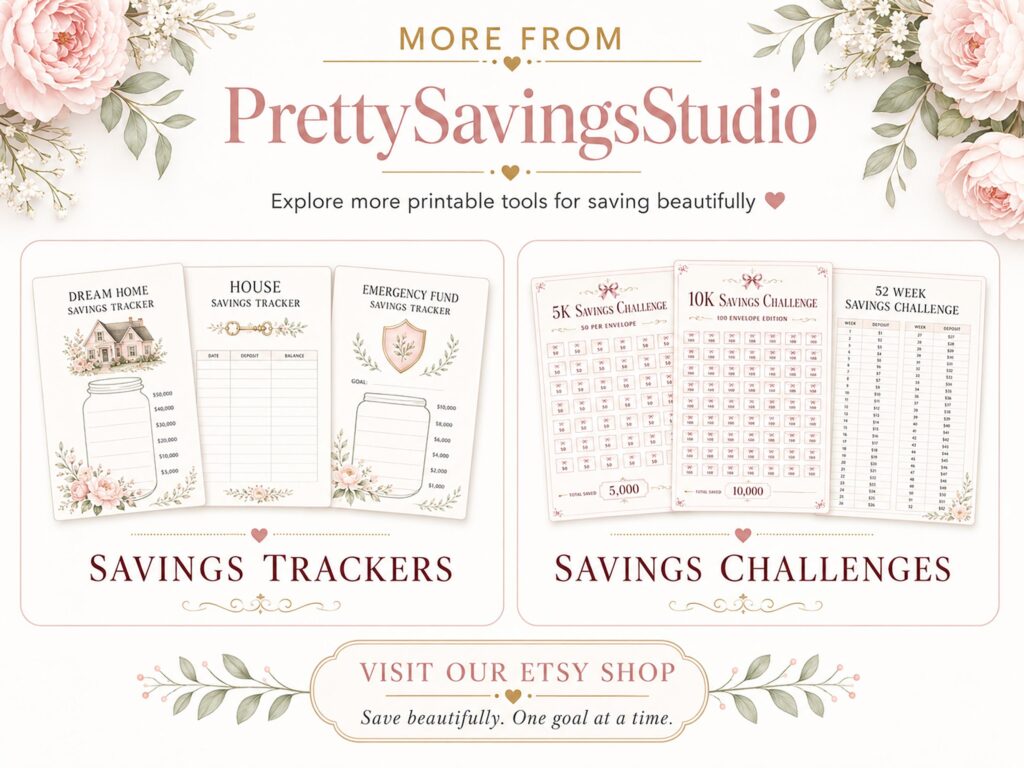
Pretty Savings Studio
Pretty tools for your more beautiful and organized life:
If you are trying to learn how to save money, this approach is often more useful than constantly searching for new money saving hacks.
You do not need to be perfect with money.
You need a clear plan that is easy enough to continue.
1. Start With a Clear Savings Goal
Saving is much easier when the money has a purpose.
Instead of saying:
I want to save more money.
Choose a specific goal.
For example:
- save $1,000 for an emergency fund;
- save $2,000 for a vacation;
- save for Christmas;
- save for a car;
- save for a wedding;
- save for a new phone;
- save for a home down payment;
- save for a special purchase.
A clear goal gives your savings a reason.
It also helps you decide how much money you need and how long it may take.
If you have several goals, choose one priority first.
You can add more later.
2. Decide How Much You Need to Save
Once you know your goal, turn it into a number.
For example:
Goal: $1,200
Deadline: 12 months
Now divide:
$1,200 ÷ 12 = $100 per month
If you are paid twice a month, you could save:
$50 per paycheck
This makes the goal feel more realistic.
Large goals often feel difficult because we look only at the final number.
Breaking the total into smaller amounts creates a simple savings plan.
3. Save Money Before You Spend It
One of the best money saving methods is also one of the simplest:
save first.
Many people do the opposite.
They pay bills, shop, eat out, buy small things, and then hope there is something left to save.
Often there is not.
Try this instead:
Income arrives → savings are transferred → the rest is available for spending
This is sometimes called paying yourself first.
You can start with a small amount.
For example:
- $10 per paycheck;
- $25 per paycheck;
- $50 per month;
- $100 per month.
The amount can grow later.
The most important thing is making saving part of your normal routine.
4. Automate Your Savings
If possible, automate your transfer.
This removes one decision from your month.
Instead of thinking:
Should I save money this week?
the money moves automatically.
For example:
Every payday: $40 goes to savings
or:
First day of every month: $100 goes to savings
Automatic saving can be especially helpful if you tend to spend money first and think about savings later.
Choose an amount that fits comfortably with your regular expenses.
A savings plan should help you, not create new financial stress.
5. Keep Savings Separate From Everyday Money
If your savings are mixed with your normal spending money, it can be easy to use them.
Keeping savings separate creates a clear boundary.
You could use:
- a separate savings account;
- savings categories in your banking app;
- sinking funds;
- cash envelopes for suitable short-term goals.
The important thing is knowing:
This money already has a job.
If it is for a vacation, it is not extra shopping money.
If it is for an emergency fund, it is not money for entertainment.
Giving every savings goal a purpose makes it easier to protect.
6. Focus on Your Biggest Spending Opportunities
You do not need to save a few cents on everything.
Start with expenses that can make the biggest difference.
Review your spending and ask:
- Am I paying for subscriptions I do not use?
- Am I eating out more often than I want?
- Do I impulse buy online?
- Am I buying clothes or beauty products I do not need?
- Do I pay for convenience because I do not plan ahead?
- Are there bills I can reduce?
Saving $40 from one recurring expense may be easier than trying to save $1 forty different times.
This is why the best way to save money is usually not about extreme frugality.
It is about choosing the right places to cut.
7. Reduce Spending You Do Not Value
You do not have to remove everything enjoyable from your life.
That approach is hard to maintain.
Instead, cut spending that does not give you much value.
For example, you might:
- cancel an unused membership;
- reduce takeout;
- stop buying duplicate beauty products;
- wait before making online purchases;
- use what you already own;
- plan groceries before shopping;
- choose free entertainment more often.
The goal is not to make life unpleasant.
The goal is to redirect money from things you barely care about toward goals you care about more.
8. Move Saved Money Immediately
This step is often forgotten.
Imagine you decide not to buy a $30 item.
You have technically saved $30.
But if that money stays in your checking account, you may spend it on something else later.
A better approach is:
Purchase skipped → $30 moved to savings
Do the same when you:
- cancel a subscription;
- spend less on groceries;
- sell an unused item;
- receive a refund;
- avoid takeout;
- complete a no-spend day.
This turns money saving ideas into real savings.
9. Use a Savings Tracker
Saving becomes easier when you can see progress.
A savings tracker helps you record how much you have already saved and how much remains.
For example, imagine you want to save $1,000.
You could use a savings goal tracker with 50 sections.
Each section represents:
$20
Every time you save $20, you mark or color one section.
Over time, the tracker fills up.
You can use:
- a printable savings tracker;
- a saving tracker;
- a money saving tracker;
- a money savings tracker;
- a savings planner;
- a notebook;
- a spreadsheet.
Choose the method you are most likely to keep using.
Visual progress can make a long-term goal feel much more achievable.
10. Try a Savings Challenge
Some people stay motivated better when saving feels like a challenge.
A savings challenge gives you a simple structure to follow.
Popular options include:
- 30 day savings challenge;
- 52 week savings challenge;
- 100 envelope challenge;
- weekly savings challenge;
- monthly savings challenge;
- no-spend challenge;
- fixed-amount money saving challenge.
The best challenge is not necessarily the biggest one.
Choose something realistic.
A small saving challenge you finish is more useful than a difficult one you quit.
Savings challenges can work especially well when you are saving for a short-term goal.
11. Save Unexpected Money
Extra money can help you reach savings goals faster.
When you receive money you were not expecting, consider saving part of it.
Examples include:
- bonuses;
- refunds;
- cash gifts;
- rebates;
- money from selling unused items;
- tax refunds;
- returned deposits.
You can create your own rule.
For example:
Save 50% of unexpected money.
Or:
Save 100% until my current goal is reached.
A simple rule makes the decision easier.
12. Make Impulse Buying Harder
Impulse spending can quietly undo a good savings plan.
One easy solution is to create a waiting period.
For example:
- wait 24 hours before small nonessential purchases;
- wait three days before larger purchases;
- add items to a wishlist instead of buying immediately.
Then ask yourself:
Do I still want this?
and:
Do I want this more than I want my savings goal?
Many purchases feel less important after a little time.
This can be one of the easiest ways to save money without feeling deprived.
13. Review Your Savings Once a Month
A savings plan does not need daily attention.
A simple monthly review is often enough.
Ask yourself:
- How much did I save?
- Am I still on track?
- Did I overspend somewhere?
- Can I increase my savings slightly?
- Do I need to adjust my goal or deadline?
Your plan can change.
The important thing is continuing.
If one month is difficult, save less.
If another month is easier, save more.
A flexible plan is often easier to maintain than a rigid one.
What Is the Best Way to Save Money on a Low Income?
If your income is limited, the best strategy is not to copy someone else’s savings amount.
Start with what is realistic for you.
That may be:
- $5 per week;
- $10 per paycheck;
- $25 per month.
Small savings still matter.
You can also focus on:
- reducing one recurring expense;
- avoiding impulse purchases;
- selling unused items;
- saving part of any unexpected money;
- using a simple savings challenge.
The goal is to create progress without making everyday life harder than it already is.
What Is the Best Way to Save Money Every Month?
For most people, the simplest monthly system is:
1. Choose a goal.
Know what you are saving for.
2. Choose a monthly amount.
Keep it realistic.
3. Automate the transfer.
Move the money soon after you get paid.
4. Reduce one or two unnecessary expenses.
Do not try to cut everything.
5. Track the result.
Use a savings tracker or savings planner.
That is enough.
You do not need dozens of complicated money saving strategies.
What Is Better: Saving More or Spending Less?
Usually, both can help.
But when you are starting, spending less can be easier to control.
You can quickly review:
- subscriptions;
- food spending;
- shopping;
- convenience purchases;
- entertainment.
Then redirect the money you save.
Over time, increasing your income can make larger savings goals easier, but your basic saving system should still remain simple.
The Best Money Saving System Is the One You Can Keep
There is no single perfect method for everyone.
The best way to save money is the one you can repeat without constantly starting over.
For most people, that means:
- choose one savings goal;
- save before spending;
- automate when possible;
- reduce low-value expenses;
- move saved money immediately;
- track your progress;
- review your plan regularly.
You do not need to make dramatic changes.
You need a system that works in real life.
Start small.
Stay consistent.
Let your savings grow over time.
A printable savings tracker, saving planner, or money saving challenge can help you stay focused and make your progress easier to see.
Explore our savings trackers and savings challenges and choose a simple tool for your next savings goal:
Pretty Savings Studio
Pretty tools for your more beautiful and organized life: