Saving money does not always require a strict budget, major lifestyle changes, or hours spent comparing every price. Some of the best easy ways to save money are small changes that require very little effort once you put them in place.
You can automate a transfer.
Cancel something you do not use.
Wait before buying.
Move small amounts into savings.
These changes may not feel dramatic, but together they can make a real difference.
If you want to learn how to save money without making your daily life complicated, start with a few easy ideas and let them become part of your routine.
Here are 20 low-effort ways to begin.
Pretty Savings Studio
Pretty tools for your more beautiful and organized life:
1. Automate a Small Savings Transfer
One of the easiest ways to save is to make the decision only once.
Set up an automatic transfer from your checking account to savings.
For example:
$25 every payday
or:
$50 on the first day of every month
After that, the money moves automatically.
You do not have to remember.
You do not have to decide every time.
Start with an amount that feels comfortable.
You can increase it later.
2. Round Up Your Savings
If your bank offers an automatic round-up feature, consider using it.
For example, if you spend:
$7.40
your bank may round the purchase to:
$8.00
and move the extra:
$0.60
into savings.
Each amount is tiny.
But over many purchases, the total can grow without requiring much effort.
3. Cancel One Subscription Today
You do not need to cancel everything.
Find one subscription you barely use.
It could be:
- a streaming service;
- an app;
- a membership;
- software;
- a delivery service.
If it costs $12 per month, canceling it saves:
$144 per year
Then move that $12 into savings each month.
One five-minute decision can continue saving money for you all year.
4. Unsubscribe From Shopping Emails
Sale emails are designed to make you want things you were not planning to buy.
If promotional messages regularly tempt you, unsubscribe.
Also consider turning off:
- sale notifications;
- shopping app alerts;
- price-drop messages;
- promotional texts.
The less often you see an offer, the less often you have to resist it.
Sometimes the easiest way to spend less is simply to see fewer things to buy.
5. Remove Saved Payment Details
Online shopping becomes very easy when your card information is already saved.
Make it slightly less convenient.
Remove saved card details from stores where you tend to impulse shop.
Now a purchase requires a few extra steps.
That small pause gives you time to reconsider whether you really want the item.
6. Use the 24-Hour Rule
Before buying a nonessential item, wait 24 hours.
Do not tell yourself you can never have it.
Simply wait.
If you still want it the next day, you can decide again.
Many impulse purchases lose their appeal quickly.
This habit takes almost no work and can prevent a surprising amount of unnecessary spending.
7. Put Wants on a Wishlist
When you see something you like, add it to a wishlist instead of buying it immediately.
This works especially well for:
- clothing;
- beauty products;
- home decor;
- books;
- accessories;
- electronics.
Review your list once or twice a month.
You may find that many items no longer interest you.
A wishlist gives you time to choose what is truly worth buying.
8. Shop From Your Home First
Before buying something, check whether you already have an alternative.
This works particularly well for:
- food;
- toiletries;
- cleaning products;
- makeup;
- skincare;
- stationery.
You may already own three versions of something you are about to buy again.
Using what you have first is one of the easiest money saving habits to build.
9. Keep One Easy Meal at Home
Takeout often happens because you are tired and there is nothing easy to eat.
Keep one or two very simple meals available for those days.
For example:
- frozen meals;
- pasta;
- soup;
- eggs;
- sandwiches;
- another quick option you actually like.
You do not need a complicated meal-prep routine.
You simply need an easier alternative to ordering food.
10. Carry Water With You
Buying drinks when you are out can become a regular expense.
A reusable water bottle solves the problem with almost no daily effort.
Fill it before you leave home.
This is a small habit, but small recurring expenses are exactly the ones that quietly add up.
11. Create One No-Spend Day Each Week
You do not need a full no-spend month.
Start with one day.
On that day, avoid nonessential purchases.
For example:
Tuesday = no-spend day
You can still pay bills and buy something necessary.
The goal is simply to create one regular break from casual spending.
If that feels easy, add a second day later.
12. Save Every Refund
Create one rule:
Refunds go to savings.
This may include:
- returned purchases;
- rebates;
- canceled orders;
- price adjustments;
- other small refunds.
Because the money has already left your account once, moving it into savings may feel easier than saving the same amount from your normal spending money.
13. Save Part of Unexpected Money Automatically
Use the same idea for unexpected income.
For example:
Save 50% of every unexpected dollar.
This could include:
- cash gifts;
- bonuses;
- rebates;
- tax refunds;
- money from selling something.
You do not need to decide every time.
You already have the rule.
That makes saving easier.
14. Increase Your Savings by a Tiny Amount
You do not have to make a big change.
If you currently save $50 each month, increase it to:
$55
Later, increase it to:
$60
Then:
$70
Small increases are easier to absorb into your normal budget.
Over time, they can make a meaningful difference.
15. Transfer the Amount You Did Not Spend
Whenever you decide not to buy something, save part or all of that amount.
For example:
You almost bought a $30 shirt.
You decide you do not really need it.
Transfer:
$30 into savings
Now you can see exactly what that decision gave you.
This can turn saying “no” to a purchase into something positive.
16. Make Your Savings Goal Visible
Keep your savings goal somewhere you will notice it.
You might use:
- a note on your phone;
- a printable savings tracker;
- a photo of your goal;
- a savings planner;
- a tracker on your desk.
If you are saving for a vacation, house, car, or another specific goal, seeing it regularly can help you remember why you are saving.
You do not need to think about money all day.
A small visual reminder is enough.
17. Use a Savings Tracker
A savings tracker is an easy way to make your progress visible.
Suppose your goal is $1,000.
You could use a savings goal tracker divided into 50 sections.
Each section represents:
$20
Whenever you save another $20, mark one section.
You can use:
- a printable savings tracker;
- a saving tracker;
- a money saving tracker;
- a money savings tracker;
- a savings planner.
Seeing the tracker fill up can make saving feel more satisfying.
18. Try an Easy Savings Challenge
A savings challenge does not need to be difficult.
Choose something small.
For example:
- save $5 every Friday;
- save $10 every payday;
- have one no-spend day each week;
- save all $5 bills you receive in cash;
- transfer $20 at the end of every month.
The best money saving challenge is one that fits naturally into your life.
If it feels too difficult, choose a smaller one.
19. Create a Separate Savings Account
Keeping savings away from everyday spending can make them easier to protect.
If possible, use a separate account for your savings.
You can even give it a name:
Emergency Fund
Vacation
Christmas
New Car
A named account makes the purpose clear.
It can also reduce the temptation to treat savings as extra spending money.
20. Review Your Savings Once a Month
You do not need to track every dollar every day.
Once a month, take a few minutes to check:
- how much you saved;
- whether your automatic transfers worked;
- whether any subscriptions should be canceled;
- whether you can increase your savings slightly.
Keep the review short.
Saving should not become another complicated job.
Easy Ways to Save $100 a Month
You do not necessarily need one large change to save $100.
You could combine several easy ones.
For example:
Cancel one subscription: $15
Reduce one takeout order: $25
Use a no-spend day: $20
Avoid one impulse purchase: $25
Save one refund: $15
Total:
$100
Your numbers will be different.
The point is that several small changes can work together.
Easy Ways to Save Money Without Feeling Deprived
Start with things you barely notice.
For example:
- unused subscriptions;
- random impulse purchases;
- duplicate products;
- delivery fees;
- shopping triggered by promotional emails.
Keep spending on things that genuinely matter to you.
Saving does not need to mean removing every pleasure from your life.
It can simply mean becoming more selective.
Easy Ways to Save Money on a Low Income
If your income is limited, focus on actions that do not require a large monthly savings amount.
You might:
- automate $5 per week;
- save small refunds;
- use what you already own;
- wait before nonessential purchases;
- try a small savings challenge;
- track each amount you save.
Even small amounts count.
The goal is to make saving easier, not harder.
Which Easy Money Saving Ideas Should You Try First?
Choose three that require almost no effort.
For example:
1. Automate a small transfer.
2. Cancel one unused subscription.
3. Use the 24-hour rule before shopping.
Do those first.
Once they become normal, add another.
You do not need to use all 20 ideas at once.
Make Saving Easier, Not More Complicated
The best easy ways to save money are the ones that reduce effort.
Automate what you can.
Remove unnecessary temptations.
Use simple rules.
Save small amounts regularly.
Track your progress.
You do not need to think about money every day to build savings.
A few low-effort habits can continue working in the background while you focus on the rest of your life.
Over time, these small actions can help you build an emergency fund, prepare for future expenses, and reach important savings goals.
A printable savings tracker, savings planner, or easy money saving challenge can make the process even simpler and help you see your progress as it grows.
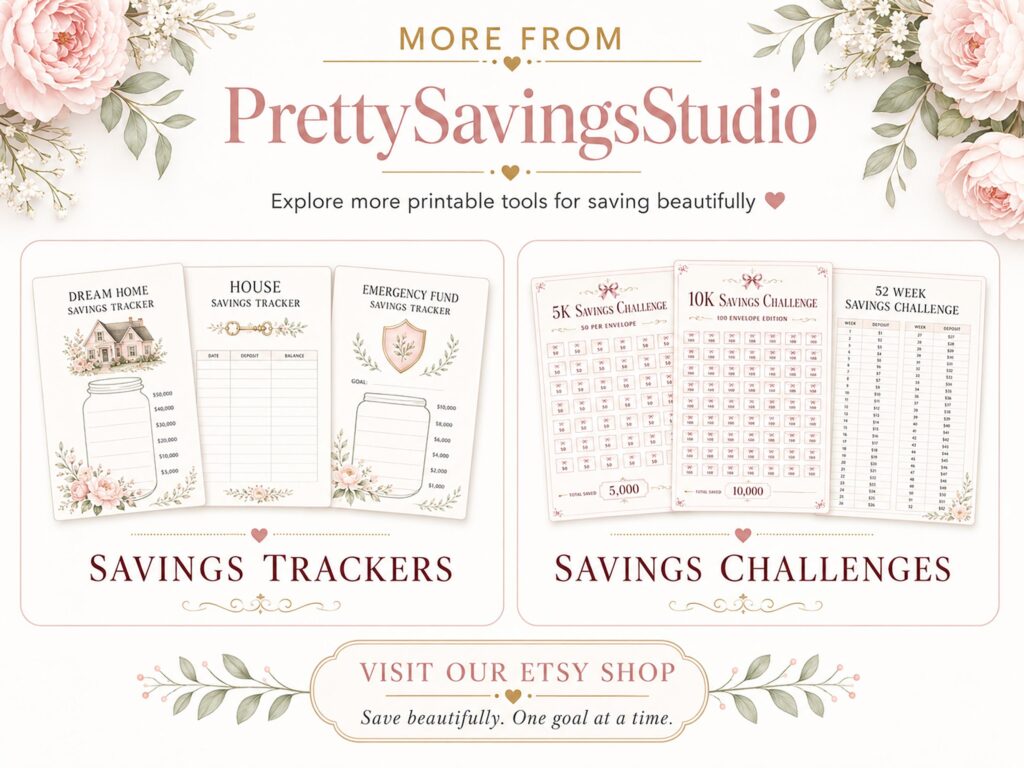
Explore our savings trackers and savings challenges and choose an easy tool for your next savings goal:
Pretty Savings Studio
Pretty tools for your more beautiful and organized life: