Learning how to save money for a wedding becomes much easier when you stop thinking about the wedding as one enormous expense.
Instead, break it into smaller categories and create one clear wedding savings goal.
Your wedding fund may need to cover things like:
- venue;
- food and drinks;
- wedding attire;
- photography;
- flowers and decor;
- music or entertainment;
- invitations;
- transportation;
- beauty;
- rings;
- cake;
- tips;
- last-minute expenses.
The exact list depends on the wedding you want.
The goal is not to spend as little as possible.
It is to decide what matters most to you, build a realistic budget around those priorities, and save for the wedding without creating unnecessary financial stress.
Here is how to start.
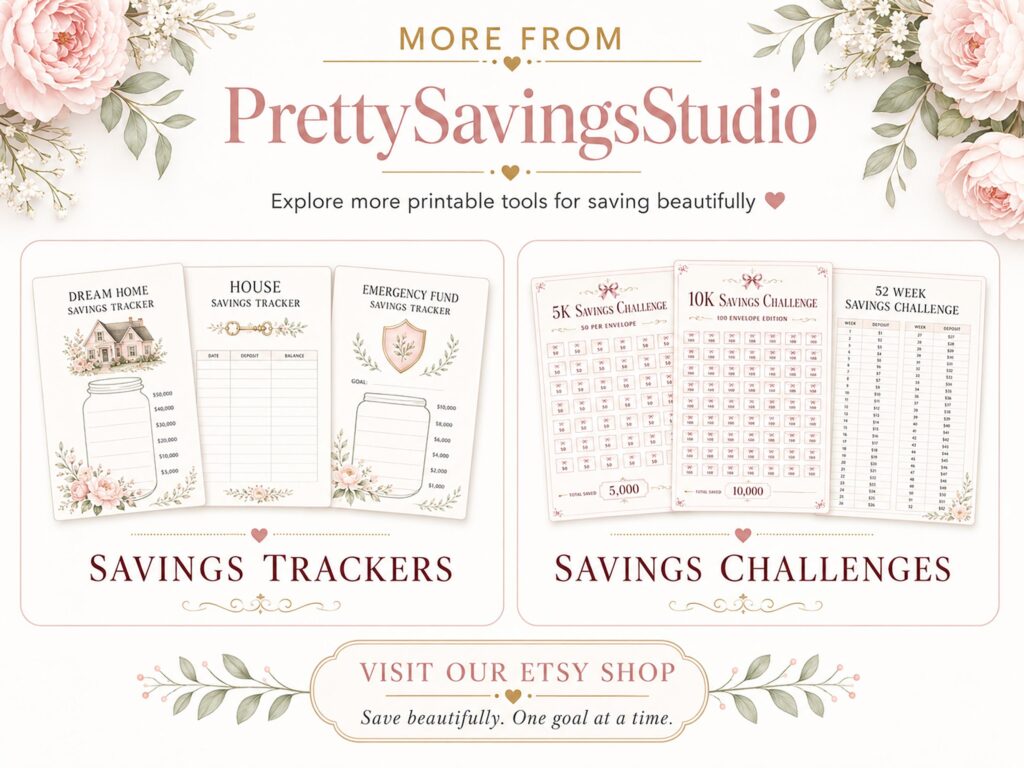
Pretty Savings Studio
Pretty tools for your more beautiful and organized life:
1. Decide What Kind of Wedding You Want
Before choosing a savings number, think about the wedding itself.
Ask:
- How many guests do we want?
- Do we want a traditional wedding?
- Would we prefer something small and intimate?
- Is the venue very important?
- Do we care more about food, photography, flowers, or entertainment?
- Are there things we do not care about at all?
This matters because two weddings can have completely different budgets.
A wedding for 30 guests will require a different savings goal from one for 150.
Start with the experience you want.
Then build the budget.
2. Choose Your Wedding Budget
Set a working total.
For example:
Wedding budget: $20,000
This does not mean you must spend every dollar.
It gives you a limit to plan around.
You can adjust the number later as you research real prices.
Without a total budget, it is easy for individual wedding decisions to grow without realizing how much they add up to.
3. Divide the Wedding Into Categories
Now break your total budget into smaller pieces.
For example:
Venue and catering: $9,000
Photography: $2,000
Attire: $1,500
Flowers and decor: $1,500
Music: $1,200
Invitations and stationery: $500
Cake: $600
Beauty: $500
Transportation and other costs: $1,200
Buffer: $2,000
Total:
$20,000
Your categories will be different.
The purpose is to see where the money is actually going.
4. Include a Wedding Buffer
Wedding budgets can easily grow because of small expenses that were not included at the beginning.
You may suddenly need:
- alterations;
- delivery fees;
- service charges;
- extra decor;
- tips;
- transportation;
- last-minute supplies;
- additional guests.
That is why it is useful to include a buffer.
For example:
Planned wedding expenses: $18,000
Buffer: $2,000
Total savings goal:
$20,000
If you do not use the full buffer, you will simply have money left after the wedding.
That is much better than discovering you are short before the event.
5. Subtract Money You Already Have
If you already have wedding savings, subtract them.
For example:
Wedding goal: $20,000
Already saved: $5,000
Still needed:
$15,000
This is the real amount you need to build.
If family members have definitely committed to contributing a specific amount, you can include that too.
Avoid building your plan around money that is uncertain.
6. Create a Separate Wedding Fund
Keep wedding savings separate from everyday money if possible.
You might use:
- a dedicated savings account;
- a separate savings category;
- another clearly labeled savings space.
Name it:
Wedding Fund
or:
Our Wedding
This makes it easier to see exactly how much you have available.
It also reduces the temptation to use wedding money for unrelated spending.
7. Decide What Matters Most
One of the best ways to control wedding costs is to decide where you actually want to spend.
Choose two or three priorities.
For example:
Photography + food + venue
Then identify areas where you are happy to spend less.
You may care less about:
- expensive invitations;
- elaborate favors;
- luxury transportation;
- large floral installations;
- multiple outfit changes.
This approach is much easier than trying to make every category cheap.
Spend intentionally on what matters most.
Save on what does not.
8. Look at the Guest List Carefully
Guest count can affect several major wedding expenses.
More guests can mean higher costs for:
- catering;
- drinks;
- tables and chairs;
- invitations;
- favors;
- venue size;
- cake;
- transportation.
That does not mean you should automatically cut people you want at your wedding.
But it does mean the guest list is an important financial decision.
Before adding someone, understand what another guest may add to the total budget.
9. Compare Vendors Before Booking
Do not automatically book the first vendor you like.
Compare:
- prices;
- packages;
- what is included;
- extra fees;
- cancellation policies;
- minimum spending requirements.
A cheaper quote is not always the better deal if important services cost extra.
Look at the full price.
Saving $500 or $1,000 on one major vendor can make a much bigger difference than cutting dozens of tiny wedding purchases.
10. Watch for Small Wedding Extras
Small purchases can quietly grow into a large amount.
For example:
- personalized signs;
- matching accessories;
- favors;
- decorative boxes;
- extra stationery;
- guest books;
- small decor pieces;
- novelty items.
Each purchase may seem inexpensive.
Together, they can become hundreds or even thousands of dollars.
Before buying something, ask:
Will this noticeably improve our wedding?
If not, consider skipping it.
11. Avoid Buying Everything Too Early
Wedding excitement can lead to early impulse purchases.
You may buy decor before choosing the venue.
Or accessories before choosing the dress.
Or favors before knowing the final guest count.
This can result in wasted money.
Create your main plan first.
Then buy things when you know they fit the wedding you are actually having.
12. Redirect Everyday Spending Into the Wedding Fund
Look for expenses you would happily trade for your wedding.
For example:
Reduced takeout: $100 per month
Less shopping: $100
Canceled subscriptions: $30
Fewer expensive weekends out: $120
Total:
$350 per month
In one year:
$350 × 12 = $4,200
You do not need to cut every enjoyable expense.
Choose spending that matters less to you than the wedding.
13. Create a “Wedding Instead” Rule
Whenever you decide not to buy something unnecessary, transfer some or all of that amount to the wedding fund.
For example:
Skipped $60 shopping purchase:
$60 → wedding fund
Canceled $20 subscription:
$20 → wedding fund
Skipped $75 night out:
$75 → wedding fund
The money now has a positive purpose.
You are not simply giving something up.
You are moving closer to your wedding.
14. Save Part of Extra Money
Unexpected money can make a big difference when you are saving for a large event.
Consider adding part of:
- bonuses;
- tax refunds;
- cash gifts;
- rebates;
- refunds;
- extra income;
- money from selling unused items.
You might create a rule:
50% of extra money goes to the wedding fund.
If the wedding is your main short-term goal, you may choose a higher percentage.
15. Sell Things You No Longer Use
Unused items can become wedding money.
Look for:
- clothing;
- electronics;
- furniture;
- handbags;
- home decor;
- hobby equipment;
- other items you no longer need.
If you sell items for:
$500
transfer that $500 directly into the wedding fund.
Do not let it disappear into everyday spending.
16. Be Careful With Wedding Trends
Wedding trends can be beautiful.
They can also make you feel as though you need things you had never wanted before.
Before adding a new expense, ask:
Would I have wanted this if I had not seen it online?
If the answer is no, you may not need it.
Your wedding does not have to contain every current wedding trend to feel special.
17. Consider Where DIY Actually Saves Money
Doing something yourself can save money.
But not always.
DIY may involve:
- materials;
- tools;
- shipping;
- mistakes;
- time;
- extra supplies.
Compare the real DIY cost with simply buying or hiring.
DIY is most useful when:
- you enjoy doing it;
- materials are inexpensive;
- you already have the tools;
- the project is realistic.
Do not turn wedding savings into dozens of stressful projects.
18. Protect the Wedding Fund
Once money goes into your wedding savings, try not to use it for normal spending.
Before withdrawing from the fund, ask:
Is this more important than our wedding goal?
Sometimes an emergency genuinely will be.
But keeping the money separate creates an extra barrier against casual spending.
19. Create Wedding Savings Milestones
A large wedding goal may take months or years to reach.
Break it into smaller amounts.
For a $20,000 wedding fund:
$2,500
$5,000
$10,000
$15,000
$20,000
You can also connect milestones to future wedding expenses.
For example:
First milestone → venue deposit
Second milestone → photographer
Third milestone → remaining major vendors
This makes progress feel more practical.
20. Use a Wedding Savings Tracker
A savings tracker can help you see your progress.
Suppose your goal is:
$15,000
You might use a savings goal tracker divided into 50 sections.
Each section represents:
$300
Every time you save another $300, mark one section.
You can use:
- a printable wedding savings tracker;
- a saving tracker;
- a money saving tracker;
- a wedding savings planner;
- a spreadsheet.
Visual progress can make a long-term goal much more motivating.
How Much Money Should You Save for a Wedding?
There is no single correct number.
Your wedding savings goal depends on:
- guest count;
- location;
- venue;
- food and drinks;
- wedding style;
- priorities;
- what you can realistically afford.
Start with the wedding you want.
Then compare it with what you can comfortably save.
If the numbers do not work together, adjust the wedding before committing to expenses.
How to Save Money for a Wedding on a Low Income
A lower income may mean:
- a longer engagement;
- a smaller wedding;
- fewer guests;
- lower-cost vendors;
- fewer optional extras.
Start with an amount you can actually save.
For example:
$100 per month
Then increase it when possible:
$150 → $200 → $300
Add occasional extra money too.
Your wedding does not need to match someone else’s budget.
It needs to fit your life.
How to Save Money for a Wedding in One Year
Suppose you need:
$12,000
and have:
12 months
You would need:
$12,000 ÷ 12 = $1,000 per month
If you already have $3,000 saved:
Still needed:
$9,000
$9,000 ÷ 12 = $750 per month
If that number is unrealistic, you can change:
- the wedding budget;
- the date;
- the guest list;
- the amount of extra income used for the wedding.
Should You Use Credit for Wedding Expenses?
A wedding can make it tempting to spend beyond the money available.
Before borrowing for optional wedding upgrades, consider what those expenses will feel like after the wedding is over.
A smaller wedding that is comfortably funded may give you more financial freedom afterward.
If something does not fit the budget, look first at:
- reducing the expense;
- changing the option;
- extending the savings timeline.
Can a Savings Challenge Help Pay for a Wedding?
Yes.
A savings challenge can be an additional way to grow your wedding fund.
For example:
Regular wedding savings:
$500 per month
Plus a yearly money saving challenge:
$1,000
That gives you an extra $1,000 toward the wedding.
You might use:
- fixed-amount savings challenge;
- 52 week savings challenge;
- no-spend challenge;
- goal-based wedding savings challenge.
Build the Wedding Fund Around What Matters to You
Learning how to save money for a wedding is not about making every part of your wedding inexpensive.
It is about deciding what matters, creating a realistic total, and using your money intentionally.
Choose your wedding priorities.
Build the full budget.
Include a buffer.
Create a separate wedding fund.
Cut spending that matters less.
Add extra money when possible.
Track your milestones.
And avoid spending simply because something is considered a wedding “must-have.”
A printable wedding savings tracker, savings planner, or money saving challenge can help you keep the goal visible and see how every contribution brings your wedding closer.
Explore our wedding savings trackers and choose a simple tool to help you build your wedding fund one milestone at a time:
Pretty Savings Studio
Pretty tools for your more beautiful and organized life: