Trying to figure out how to save money when you are broke can feel impossible. When almost every dollar already has a job, advice like “save 20% of your income” may not be useful.
You may be dealing with rent, groceries, bills, transportation, debt payments, or unexpected expenses. By the end of the month, there may be little or nothing left.
In that situation, the goal is not to create a perfect financial plan.
The first goal is much smaller:
Create a little breathing room.
Even saving $5, $10, or $20 can be a beginning.
If you want to learn how to save money when finances are extremely tight, start with what is possible right now.
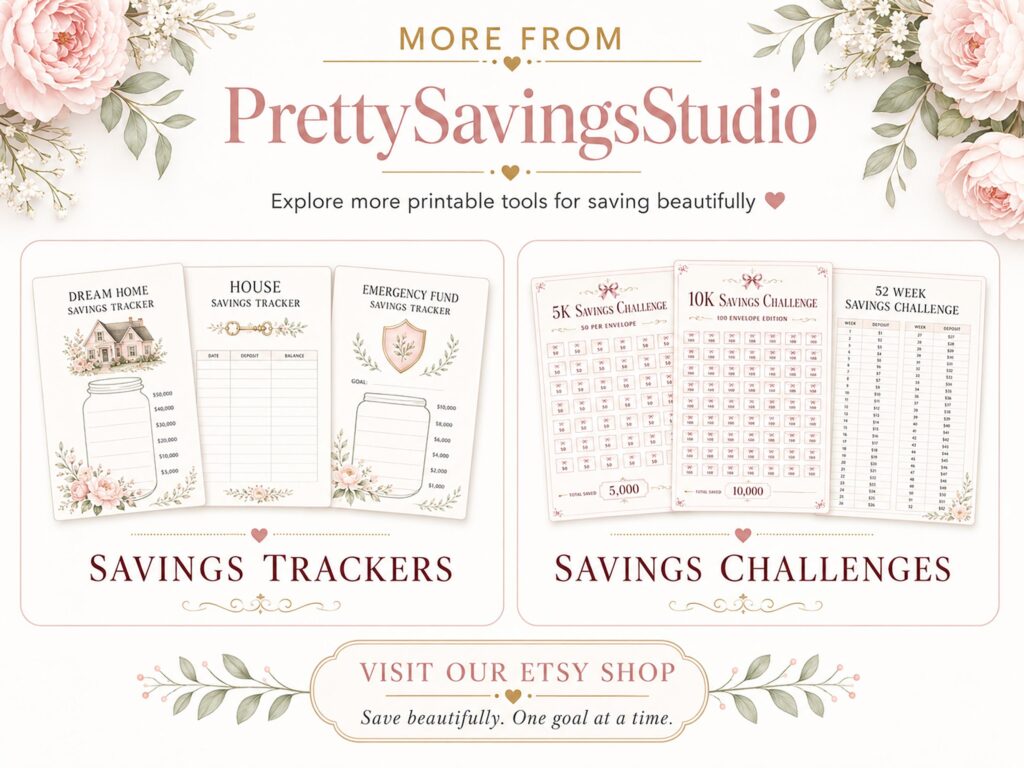
Pretty Savings Studio
Pretty tools for your more beautiful and organized life:
1. Forget the Perfect Savings Percentage
You do not need to save 10%, 20%, or any other fixed percentage just because someone recommends it.
When money is extremely tight, your savings amount may be:
- $2;
- $5;
- $10;
- $20.
That still counts.
The important thing is to start creating a small gap between what comes in and what goes out.
You can increase the amount later.
2. Protect Your Essential Expenses First
When you are broke, saving should not come before basic needs.
Start with essentials such as:
- housing;
- food;
- utilities;
- necessary transportation;
- medication and healthcare;
- required insurance;
- other essential obligations.
Do not skip groceries or an important bill just to say you put money into savings.
Your first money saving plan should protect the basics.
Then look at what remains.
3. Find Your First $10
Do not start by asking:
How can I save $1,000?
Ask:
How can I find my first $10?
That may come from:
- skipping one nonessential purchase;
- canceling a small subscription;
- spending less on one grocery trip;
- returning something you do not need;
- selling one unused item.
Once you save $10, look for the next $10.
Large savings often begin with very small amounts.
4. Check Where Small Amounts Are Disappearing
When money is tight, even small purchases matter.
Look through your recent spending.
Pay attention to:
- convenience-store purchases;
- delivery fees;
- snacks;
- coffee;
- app purchases;
- subscriptions;
- small online orders;
- bank or service fees.
You do not have to remove everything.
Look for expenses you barely value.
Saving $5 here and $10 there may be enough to begin your first small savings fund.
5. Stop Spending Leaks Before Making Big Cuts
A spending leak is money that leaves your account without giving you much value.
For example:
- a subscription you forgot about;
- a membership you rarely use;
- duplicate products;
- unnecessary delivery fees;
- automatic renewals.
These are good places to start because cutting them may not affect your daily life much.
If you cancel a $12 subscription, move the $12 into savings.
Now you have created progress without taking money away from an essential expense.
6. Use What You Already Have
Before buying anything that is not essential, check your home first.
Look at:
- pantry food;
- freezer food;
- toiletries;
- cleaning products;
- makeup;
- skincare;
- clothing;
- household supplies.
You may already have enough to avoid several purchases.
Try a short “use what you have” period.
Every purchase you avoid gives your budget a little more room.
7. Create a Bare-Bones Week
If you need immediate breathing room, try one very low-spend week.
For seven days, focus only on:
- essential bills;
- groceries you truly need;
- necessary transportation;
- healthcare and other essentials.
Pause nonessential spending such as:
- takeout;
- shopping;
- paid entertainment;
- beauty purchases;
- random online orders.
This is temporary.
The goal is to see how much money you can free up in one week.
8. Put Nonessential Purchases on Hold
When you are broke, impulse buying can make an already difficult month harder.
Use a waiting rule.
For example:
Wait 48 hours before buying anything nonessential.
Put the item on a wishlist.
Then ask:
- Do I still want this?
- Do I need it right now?
- Can it wait until next month?
- Would keeping the money make me feel more secure?
You are not saying “never.”
You are saying “not yet.”
9. Sell One or Two Things
If cutting expenses does not create enough room, look for a one-time way to create cash.
You may have something you no longer use:
- clothing;
- shoes;
- handbags;
- electronics;
- small furniture;
- books;
- hobby items.
You do not need to turn selling into a business.
The goal might simply be to create your first $50 or $100 savings cushion.
If you sell something, move the money directly into savings.
10. Save Small Windfalls
When you are broke, unexpected money can disappear quickly.
Create a rule before it arrives.
If you receive:
- a refund;
- a cash gift;
- rebate;
- tax refund;
- bonus;
- returned deposit;
save at least part of it if your essential expenses are covered.
For example:
Save 25% and use the rest for current needs.
You do not have to save all of it.
A small percentage is still progress.
11. Start With a Tiny Emergency Fund
When you have no savings, even a small unexpected expense can cause problems.
That is why your first savings goal does not need to be huge.
Try:
$50 → $100 → $250 → $500
Start with the first milestone.
A $100 emergency cushion will not solve every problem, but it is better than having nothing available.
Once you reach $100, work toward the next level.
12. Use a Savings Tracker for Small Goals
A savings tracker can be especially useful when you are saving very small amounts.
Suppose your first goal is:
$100
Use a savings goal tracker with 20 sections.
Each section represents:
$5
Every time you save $5, mark one section.
Your progress becomes visible.
You can use:
- a printable savings tracker;
- a saving tracker;
- a money saving tracker;
- a savings planner;
- a notebook.
Seeing small amounts add up can help you stay motivated.
13. Try a Tiny Savings Challenge
You do not need a $5,000 or $10,000 savings challenge.
Create one that fits your situation.
For example:
$1-a-Day Challenge
Save:
$1 per day
After 30 days:
$30
$5-a-Week Challenge
Save:
$5 per week
After one year:
$260
$10 Payday Challenge
Save:
$10 every payday
Small money saving challenges can help you build the habit without putting too much pressure on your budget.
14. Keep the Money Separate
Once you save something, try not to mix it with everyday spending money.
If possible, keep it in:
- a separate savings account;
- separate savings category;
- cash envelope for an appropriate goal.
Even a small amount feels more protected when it has a separate place.
Name it:
Emergency Fund
instead of simply:
Extra Money
Money with a purpose is often easier to leave alone.
15. Do Not Give Up Because Progress Is Slow
When you are broke, savings may grow slowly.
That does not mean the effort is pointless.
Suppose you save:
Week 1: $5
Week 2: $10
Week 3: $3
Week 4: $12
That is:
$30
You may wish it were $300.
But you now have $30 more than you had before.
Keep going.
How to Save Money When You Have Nothing Left
If there is truly nothing left after essential expenses, do not force a savings transfer.
Instead, look for ways to create room.
Start by checking:
- recurring charges;
- fees;
- subscriptions;
- unused services;
- unnecessary purchases;
- items you could sell.
You can also look at whether any regular service can be changed to a lower-cost option.
If your essential expenses consistently exceed your income, small spending cuts may not be enough. In that situation, look into any local benefits, food assistance, utility assistance, payment programs, or other support you may qualify for.
The priority is stabilizing your basic situation.
How to Save $100 When You Are Broke
Make the goal smaller.
Instead of thinking about $100, think about ten $10 steps.
For example:
Cancel a subscription: $10
Sell something: $20
Reduce one shopping purchase: $15
Have a low-spend weekend: $20
Use food already at home: $15
Save a refund: $10
Avoid two small impulse purchases: $10
Total:
$100
Your exact amounts will be different.
The idea is to build the goal from several small actions.
What Should You Stop Buying When You Are Broke?
Start with purchases that are not essential and do not add much value to your life.
That may include:
- unused subscriptions;
- duplicate beauty products;
- impulse purchases;
- delivery fees;
- frequent takeout;
- unnecessary upgrades;
- random sale purchases.
But do not turn saving into extreme deprivation.
Cut what matters least first.
Should You Save Money If You Have Bills to Pay?
Essential bills should come first.
Saving money should not mean ignoring rent, utilities, food, healthcare, or other critical expenses.
If your essentials are covered and even a small amount remains, you can begin building a small emergency cushion.
The goal is greater financial stability, not moving money from one urgent problem to another.
Focus on Creating Breathing Room
Learning how to save money when you are broke starts differently than saving when you have plenty of extra income.
Do not begin with a huge target.
Begin with breathing room.
Find your first $5.
Then $10.
Then $50.
Build a small emergency cushion.
Reduce spending that gives you little value.
Protect what you manage to save.
And keep going.
Your first savings goal does not need to look impressive.
It just needs to make your financial situation slightly better than it was before.
A printable savings tracker, savings planner, or small money saving challenge can help you make every small amount visible and stay focused on building your first savings cushion.
Explore our savings trackers and savings challenges and choose a simple tool that fits your current savings goal:
Pretty Savings Studio
Pretty tools for your more beautiful and organized life: