Does saving money feel like a long list of things you are no longer allowed to enjoy?
No more coffee shops. No more restaurants. No more shopping. No vacations, hobbies, little treats, or spontaneous pleasures.
When saving money starts to sound like giving up everything that makes life enjoyable, it’s not surprising that sticking to a savings goal becomes difficult.
But there is another approach.
Learning how to save money without giving up everything means becoming more selective about where your money goes—not eliminating every enjoyable expense from your life.
You can still have a beautiful home, wear clothes you love, enjoy good food, spend time with friends, and plan exciting experiences.
The difference is that you learn to protect what matters most while spending less on things that add relatively little value.
Here are 12 practical ways to build savings without making everyday life feel like one long financial restriction.
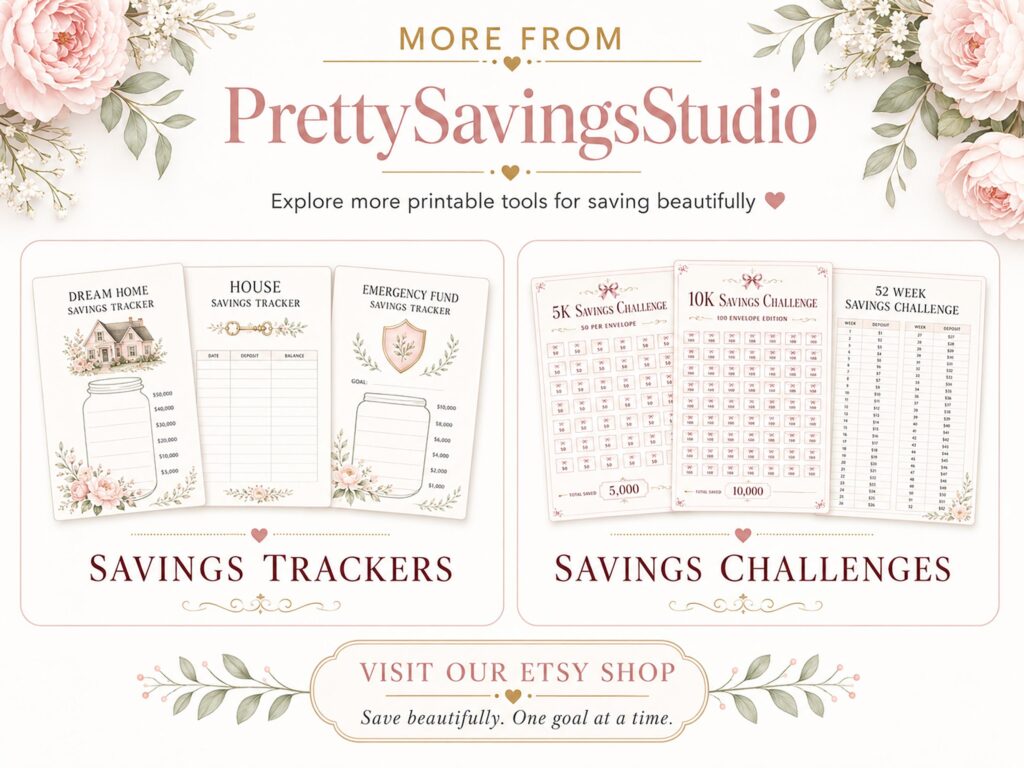
Pretty Savings Studio
Pretty tools for your more beautiful and organized life:
1. Decide What You Are Not Willing to Give Up
Before looking for things to eliminate, identify the experiences and purchases you genuinely value.
This may seem like an unusual place to start, but it can make saving money much more sustainable.
Ask yourself:
What makes my everyday life feel enjoyable?
Your answers might include:
- Good coffee in the morning.
- Occasional dinners with friends.
- Beautiful clothing and accessories.
- Travel.
- Fresh flowers at home.
- Fitness classes.
- Books.
- A favorite hobby.
- Special family activities.
Choose three to five priorities.
These are the things you want your financial plan to protect.
For example, if visiting a coffee shop every Saturday is one of your favorite weekly rituals, you do not necessarily need to eliminate it.
You may find a more comfortable place to reduce spending elsewhere.
The goal is to spend less on things you care about less—not automatically on everything.
2. Use the Keep, Reduce, Replace Method
Instead of dividing purchases into only two groups—allowed and forbidden—try a more flexible system.
KEEP
Expenses that provide meaningful enjoyment or are genuinely important to you.
Examples:
- Your favorite weekly activity.
- A hobby you regularly practice.
- A fitness membership you consistently use.
REDUCE
Expenses you enjoy but could comfortably purchase less frequently.
Examples:
- Restaurant visits.
- Food delivery.
- Nonessential shopping.
- Beauty treatments.
- Paid entertainment.
REPLACE
Expenses where a different option could provide a similar experience for less money.
Examples:
- A lower-cost mobile plan.
- A suitable store-brand household product.
- A homemade version of a favorite meal.
- A secondhand book instead of a new copy.
Here is what that might look like in practice:
| Expense | Your Decision | New Approach |
|---|---|---|
| Favorite coffee shop | Keep | Continue the weekly visit |
| Restaurant dinners | Reduce | Twice monthly instead of four times |
| Unused subscription | Replace/eliminate | Use an existing service instead |
| Clothing purchases | Reduce | Buy intentionally from a wishlist |
| Weekend activities | Replace occasionally | Mix paid experiences with free events |
This method gives your spending decisions more flexibility.
You are designing a lifestyle you can comfortably afford, not creating a punishment system.
3. Keep One Small Luxury You Truly Love
Sometimes a relatively inexpensive luxury adds disproportionate enjoyment to everyday life.
For example:
- Fresh flowers every other week.
- A favorite specialty coffee.
- A beautiful magazine.
- An occasional manicure.
- A special ingredient for a weekend meal.
If something genuinely matters to you, consider keeping it in your spending plan.
Suppose you spend $25 per month on fresh flowers and enjoy them throughout the year.
That expense may offer more personal value than $60 spent on random shopping purchases you barely remember.
You do not need to eliminate the $25 luxury to become better at saving money.
You could keep the flowers and reconsider the less meaningful $60 instead.
The key is understanding that personal value matters as much as price.
4. Reduce Frequency Instead of Eliminating the Experience
You do not always need to stop doing something to spend less on it.
Sometimes changing the frequency is enough.
For example:
Instead of ordering takeout three times per week, order once.
Instead of visiting a restaurant every weekend, go twice monthly.
Instead of purchasing new clothing every month, plan a wardrobe refresh once per season.
You can still enjoy the experience. It simply becomes a little less frequent.
Example: Restaurant Spending
Suppose your average restaurant visit costs:
$45
You currently go four times per month.
Monthly total:
$45 × 4 = $180
If you reduce this to two visits:
$45 × 2 = $90
Monthly difference:
$90
Annual equivalent:
$1,080
You have not given up restaurants.
You have simply created room for another financial priority.
5. Find Lower-Cost Versions of Experiences You Enjoy
Saving money becomes easier when you focus on preserving the experience rather than purchasing it in exactly the same way every time.
For example, perhaps you enjoy restaurant visits because you love good food and a pleasant atmosphere.
You could alternate restaurant dinners with a beautifully arranged meal at home.
If you love travel, you might combine larger vacations with smaller local trips.
If you enjoy interior design, you could restyle things you already own instead of constantly purchasing new decorations.
The essential question is:
What do I actually enjoy about this expense?
Then look for another way to experience the same thing.
A lower-cost alternative does not have to feel like a lesser life.
It can simply become another enjoyable option.
6. Create a Personal Fun Money Allowance
One reason strict savings plans fail is that they leave no room for ordinary enjoyment.
Every personal purchase becomes a difficult decision.
A small monthly fun money allowance can solve this problem.
For example:
Monthly fun money: $100
You can use it for:
- Coffee shops.
- Small personal purchases.
- Entertainment.
- Beauty products.
- Hobbies.
- Other optional activities.
The amount should fit your actual income and obligations.
The important thing is that you can enjoy spending this money without repeatedly feeling that you are undermining your financial goals.
If you spend only $70 one month, consider carrying the remaining $30 forward or adding it to savings.
Your allowance is a limit, not a requirement to spend everything.
7. Stop Making Saving an All-or-Nothing Decision
A common mistake is believing that saving money requires following every financial rule perfectly.
For example:
You decide not to buy anything unnecessary for an entire month.
Then you make one unplanned $20 purchase.
You feel that the challenge has failed, so you stop trying altogether.
A more practical approach is to allow flexibility.
Suppose your original savings target is:
$300 per month
But an unusually expensive month arrives.
You can comfortably save only:
$150
That is still progress.
You have saved half your intended amount rather than abandoning the goal completely.
You can also use two savings levels:
Minimum contribution: $50
Preferred contribution: $200
During easier months, aim for the preferred amount.
During difficult months, contribute less when necessary.
Your financial plan should adapt to your life, not require every month to look identical.
8. Use Wishlists for Things You Genuinely Want
A wishlist can help you continue enjoying fashion, beauty, technology, home decor, and other interests without purchasing every attractive item immediately.
Whenever you discover something you want, add it to a list.
For example:
| Wishlist Item | Estimated Price | Priority |
|---|---|---|
| New handbag | $180 | High |
| Perfume | $95 | Medium |
| Decorative vase | $40 | Low |
| Weekend getaway | $300 | High |
Review your wishlist occasionally.
Some things may lose their appeal. Others may remain important to you.
You can create a sinking fund for a higher-priority purchase and save toward it gradually.
For example:
Handbag goal: $180
Monthly contribution: $30
Time needed:
6 months
You are not telling yourself that you can never buy the handbag.
You are choosing to purchase it without disrupting other important goals.
A printable wishlist or savings tracker can help make planned shopping more enjoyable.
9. Make Everyday Life More Enjoyable Without Constantly Buying Something
There is a difference between enjoying life and continuously consuming new products or paid experiences.
Sometimes simple activities can provide just as much satisfaction.
For example:
- Reading in a beautiful park.
- Preparing a special breakfast at home.
- Visiting a free exhibition.
- Creating new outfits using clothes you already own.
- Taking photographs during a walk.
- Having a picnic.
- Enjoying an at-home movie evening.
- Rearranging a room using existing decor.
- Exploring an unfamiliar neighborhood.
- Spending an afternoon at the library.
These are not merely substitutes for things you cannot afford.
They can be enjoyable experiences in their own right.
The more variety you have in your everyday pleasures, the less dependent enjoyment becomes on spending money.
10. Save for Experiences Instead of Eliminating Them
Vacations, celebrations, concerts, and other special experiences do not need to disappear from your life when you decide to save more money.
You can create separate savings goals for them.
For example, suppose you want to take a vacation costing:
$1,800
You have 12 months to prepare.
Monthly vacation contribution:
$1,800 ÷ 12 = $150
Instead of trying to find $1,800 immediately before the trip, you gradually prepare for it throughout the year.
You could use the same approach for:
- Christmas.
- Birthdays.
- A special restaurant experience.
- A weekend getaway.
- A large personal purchase.
These dedicated savings categories are often called sinking funds.
They allow you to plan enjoyable spending rather than treating it as something that competes with every other savings goal.
11. Spend More Intentionally on Quality, Not Quantity
Saving money does not always mean choosing the cheapest option.
Sometimes purchasing fewer, better-suited items can reduce total spending while improving your satisfaction.
Consider clothing as an example.
You might purchase five inexpensive tops at $20 each:
Total: $100
But only wear two of them regularly.
Alternatively, you could choose one $70 item that fits beautifully, works with your wardrobe, and gets frequent use.
The second approach may provide greater personal value at a lower total cost.
Of course, expensive does not automatically mean better quality.
Consider:
- How often you will use the item.
- Whether you already own something similar.
- How well it meets your needs.
- Its expected durability.
- The total price you are comfortable paying.
The purpose is to avoid accumulating purchases that provide little lasting satisfaction.
12. Make Your Savings Goal Something You Look Forward To
Giving up an unnecessary purchase can feel disappointing when the money simply disappears into an anonymous bank balance.
But the same decision may feel very different when it helps fund something meaningful.
For example:
You decide to reduce discretionary spending by:
$75 per month
Instead of leaving that money in your checking account, transfer it to a named savings goal.
You might call the fund:
Italy Vacation
My Future Home
Dream Car
Christmas Fund
Freedom Fund
Use a printable savings tracker to make your progress visible.
For example:
Goal: $1,500
Tracker: 50 sections × $30
Every completed section represents money you have already put aside for something important.
Saving now feels less like losing an opportunity to spend today and more like choosing an opportunity you want tomorrow.
What Should You Keep and What Should You Give Up?
There is no universal list of purchases that everyone should eliminate to save money.
Something that feels unnecessary to one person may be an important source of enjoyment for someone else.
Instead, review your own expenses using this simple guide.
| Keep or Prioritize | Consider Reducing |
|---|---|
| Activities you genuinely love | Activities you pay for out of habit |
| Products you use regularly | Duplicate or rarely used products |
| Meaningful experiences | Purchases you quickly forget |
| Important personal care | Unnecessary product accumulation |
| Hobbies you actively enjoy | Supplies for hobbies you never practice |
| Planned special purchases | Repeated unplanned shopping |
| Necessary comfort and convenience | Convenience fees that offer little value |
The point is not to spend the smallest possible amount.
It is to receive more meaningful value from the money you choose to spend.
A Realistic Example: Save $200 a Month Without Giving Up Everything
Imagine that you want to save an additional $200 each month.
You enjoy restaurants, personal shopping, coffee shops, and occasional takeout.
Instead of eliminating all four categories, you make selective changes.
| Monthly Expense | Before | After | Money Saved |
|---|---|---|---|
| Restaurant Visits | $180 | $90 | $90 |
| Personal Shopping | $120 | $70 | $50 |
| Coffee Shops | $60 | $40 | $20 |
| Takeout | $100 | $60 | $40 |
| Total | $460 | $260 | $200 |
You still have:
- Restaurant visits.
- Personal shopping money.
- Coffee shop visits.
- Occasional takeout.
But your monthly spending is now $200 lower.
Over one year, assuming you maintain these changes:
$200 × 12 = $2,400
You could divide that money between:
Emergency savings: $100 per month
Vacation savings: $75
Christmas savings: $25
Total:
$200 per month
This is what balanced saving can look like in practice.
You have not eliminated enjoyment from your life. You have simply made some deliberate choices about frequency and priorities.
How to Save Money Without Giving Up Everything on a Low Income
When your income is limited, you may already have very little discretionary spending.
In that situation, advice about eliminating expensive restaurants or frequent shopping trips may not apply to your life at all.
Start by identifying what is genuinely available after essential expenses.
If you can comfortably save only $5 or $10 at a time, that is a reasonable beginning.
Avoid removing necessary food, healthcare, medications, safe transportation, or other essentials to force a savings contribution.
You may also need to look for ways to improve your financial situation that do not depend entirely on cutting purchases, such as reviewing available assistance, suitable lower-cost services, or opportunities for additional income.
A sustainable savings plan should improve your financial security without unnecessarily reducing your basic quality of life.
Try a 30-Day Save More, Enjoy More Challenge
Instead of attempting an extreme no-spend month, try a different experiment.
For 30 days, keep the enjoyable expenses that matter most while looking for less valuable spending to reduce.
Week 1: Identify Your Priorities
Choose three things you genuinely want to keep in your lifestyle.
Week 2: Reduce Frequency
Select two flexible spending habits and reduce how often they occur.
Week 3: Explore Alternatives
Try three enjoyable activities that require little or no additional spending.
Week 4: Make the Savings Visible
Calculate the amount you genuinely saved and transfer it toward a specific goal.
At the end of the challenge, ask:
Did I save more money without feeling that my life became significantly less enjoyable?
If yes, consider keeping those changes as part of your regular routine.
If a particular adjustment created too much inconvenience for very little financial benefit, replace it with a more suitable one.
The purpose is to create a system you actually want to continue.
Frequently Asked Questions
Can I save money without giving up shopping?
Yes. Consider buying less frequently, using a wishlist, setting a comfortable shopping allowance, and creating sinking funds for more expensive purchases. The objective is to make shopping intentional rather than eliminating it entirely.
How can I save money and still enjoy life?
Identify the experiences that provide the most personal value, keep room for them in your finances, and reduce less meaningful purchases. Affordable everyday pleasures can also help you enjoy life without needing to spend money constantly.
Do I have to stop eating out to save money?
Not necessarily. Reducing the frequency of restaurant visits, choosing more affordable options, or combining dining out with enjoyable meals at home may help you save while keeping the experiences you love.
How much should I spend on fun while trying to save?
There is no universal amount. Your fun money allowance should fit comfortably after essential expenses, financial obligations, and an affordable savings contribution. Choose a realistic limit rather than one that makes your lifestyle unnecessarily restrictive.
What if I feel guilty every time I spend money?
Try separating planned personal spending from your savings goals. If a purchase fits within the amount you intentionally reserved for enjoyment, you do not need to treat it as a failure to save. The goal is a sustainable balance between present and future needs.
Save More Money While Keeping the Life You Love
Learning how to save money without giving up everything begins with understanding that not all spending has equal value.
You do not need to eliminate your favorite coffee shop, stop traveling forever, abandon your hobbies, or refuse every personal purchase.
Instead, make room for the things that genuinely improve your life.
Keep your favorite pleasures.
Reduce expenses that have become automatic.
Replace selected purchases with satisfying alternatives.
Plan for larger experiences using sinking funds.
And give the money you save a purpose that feels exciting enough to work toward.
A beautiful life and a growing savings balance do not have to be competing goals.
With the right priorities, you can enjoy today while preparing for tomorrow.
A printable savings tracker, wishlist, or money saving challenge can help you organize meaningful purchases, set realistic savings goals, and turn small financial changes into visible progress.
Explore our savings trackers, printable wishlists, and money saving challenges and start saving for the things you truly want—without giving up everything you love:
Pretty Savings Studio
Pretty tools for your more beautiful and organized life: