Good money saving tips do not have to be complicated.
Often, the most useful advice is simple: know where your money goes, make fewer unplanned purchases, save before you spend, and keep your goals visible.
If you are learning how to save money, you do not need to use every tip at once.
Choose a few that fit your life.
Use them consistently.
Then add more when you are ready.
Here are 20 practical tips that can help you spend more intentionally and build your savings over time.
Pretty Savings Studio
Pretty tools for your more beautiful and organized life:
1. Give Your Savings a Specific Purpose
It is easier to save when you know what the money is for.
Instead of:
I want to save more money.
Try:
I want to save $1,500 for a vacation.
or:
I want to build a $1,000 emergency fund.
Clear savings goals make everyday spending decisions easier.
When you are tempted to buy something unnecessary, you have something more important to compare it with.
2. Save Before You Start Spending
Do not depend on whatever happens to be left at the end of the month.
There may be nothing left.
Move your planned savings amount soon after you get paid.
For example:
Paycheck → savings → bills and spending
Even a small amount counts.
You can increase it later.
3. Keep Your Savings Separate
Savings are easier to spend when they sit in the same account as your everyday money.
If possible, keep them separate.
You might use:
- a savings account;
- a separate savings category;
- a sinking fund;
- another dedicated place.
You can also name the goal:
Vacation
Emergency Fund
Christmas
New Car
Money with a clear purpose is often easier to protect.
4. Check Your Spending Before Trying to Cut It
Do not immediately start removing expenses.
First, look at what you actually spend.
Review the last few weeks or months.
Pay attention to:
- groceries;
- takeout;
- shopping;
- subscriptions;
- transportation;
- entertainment;
- beauty;
- small online purchases.
You may find that the problem is not where you expected.
5. Cut Expenses You Barely Value First
One of the best money saving tips is to start with spending you will not miss.
That might include:
- unused subscriptions;
- forgotten memberships;
- duplicate products;
- random online purchases;
- delivery fees;
- services you rarely use.
Do not begin by cutting your favorite part of your lifestyle.
Start with the easiest wins.
6. Avoid Saving Money Only “On Paper”
Suppose you decide not to buy a $30 item.
You may say:
I saved $30.
But if that $30 stays in your checking account and gets spent later, you did not really build savings.
Move it.
Purchase skipped → $30 transferred to savings
This simple step turns a good decision into real progress.
7. Use a Waiting Rule Before Buying
Not every purchase needs to happen immediately.
Try waiting:
- 24 hours for smaller purchases;
- several days for larger ones.
This is especially useful for:
- clothing;
- beauty products;
- electronics;
- home decor;
- accessories.
After the waiting period, decide again.
You may find that you no longer want the item.
8. Shop With a Purpose
Before shopping, know what you are looking for.
Use a list for:
- groceries;
- household supplies;
- clothing;
- beauty;
- gifts.
Browsing without a plan often creates new wants.
A list keeps your attention on what you actually intended to buy.
9. Do Not Buy Something Just Because It Is on Sale
A discount only saves money if you were already going to buy the item.
A $100 product reduced to $70 is not a $30 saving if you never needed it.
You still spent:
$70
Before buying a sale item, ask:
Would I want this at full price?
If the answer is no, the discount may be the reason you want it.
10. Compare the Cost With Your Savings Goal
Before an optional purchase, compare it with your goal.
For example:
New shoes: $80
Monthly vacation savings target: $200
Those shoes represent:
40% of one month’s vacation savings.
You may still decide to buy them.
The point is to make the choice consciously.
11. Watch Recurring Expenses Carefully
Small monthly charges can be more expensive than they appear.
For example:
$20 per month = $240 per year
Review subscriptions and memberships regularly.
Ask:
- Do I still use this?
- Would I sign up for it today?
- Is there a cheaper option?
Recurring expenses are important because one change can save money every month.
12. Plan for Expenses That Happen Every Year
Christmas is not unexpected.
Neither are birthdays, annual memberships, or routine car maintenance.
Create sinking funds for predictable expenses.
For example:
Expected Christmas spending: $900
Save for 12 months:
$900 ÷ 12 = $75 per month
Now the expense becomes part of your normal savings plan instead of a financial surprise.
13. Do Not Make Your Budget Too Strict
An unrealistic budget is difficult to maintain.
If you enjoy eating out, you may not need to eliminate restaurants completely.
Instead, reduce the frequency.
If you like shopping, give yourself a reasonable spending limit.
A sustainable money saving plan is usually better than a very strict plan you abandon after two weeks.
14. Keep Some Money for Enjoyment
Saving does not have to mean removing everything fun.
Create a small amount for personal spending.
For example:
Fun money: $50 per month
Use it without guilt.
Having some room for enjoyment can make the rest of your plan easier to follow.
15. Save Some of Every Windfall
Extra money is easy to spend because it feels separate from your normal income.
Create a rule before it arrives.
For example:
Save 50% of unexpected money.
This could include:
- refunds;
- bonuses;
- rebates;
- cash gifts;
- tax refunds;
- money from selling unused items.
You can enjoy some and still make progress toward your goals.
16. Increase Savings When an Expense Disappears
If you finish paying for something, do not automatically absorb that money into your normal spending.
Suppose a $60 monthly expense ends.
Move the same:
$60 per month
into savings.
You already know how to live without that money.
This makes increasing savings much easier.
17. Break Large Savings Goals Into Milestones
A goal like $5,000 can feel far away.
Break it into smaller stages:
$250 → $500 → $1,000 → $2,500 → $5,000
Each milestone gives you a visible achievement.
This can make a long savings journey feel much easier.
18. Use a Savings Tracker
A savings tracker can turn a number into visible progress.
Suppose your goal is $1,000.
Use a savings goal tracker with 50 sections.
Each section represents:
$20
Every time you save $20, mark another section.
You can use:
- a printable savings tracker;
- a saving tracker;
- a money saving tracker;
- a money savings tracker;
- a savings planner;
- a notebook or spreadsheet.
The important thing is being able to see your progress.
19. Use Savings Challenges for Extra Motivation
A savings challenge can make saving feel more structured.
You might try:
- 30 day savings challenge;
- 52 week savings challenge;
- monthly savings challenge;
- weekly savings challenge;
- 100 envelope challenge;
- no-spend challenge.
Choose a challenge that matches your budget.
A realistic money saving challenge is more useful than an impressive one you cannot finish.
20. Review Your Progress, Not Just Your Mistakes
At the end of each month, look at what worked.
Ask:
- How much did I save?
- Which change helped most?
- Where did I overspend?
- What should I continue next month?
- Can I increase my savings slightly?
Do not focus only on what went wrong.
If your savings increased, you made progress.
Money Saving Tips for Everyday Spending
For everyday spending, keep three simple questions in mind.
Before buying something, ask:
Do I need it?
Do I really want it?
Is it worth delaying my savings goal for it?
You do not have to answer “no” every time.
The purpose is simply to make spending more intentional.
Money Saving Tips for Shopping
Shopping becomes more expensive when decisions are made in the moment.
Try these simple rules:
- use a wishlist;
- wait before nonessential purchases;
- avoid browsing when you are bored;
- compare prices for larger purchases;
- ignore discounts on things you did not plan to buy;
- check what you already own first.
The goal is not to stop shopping.
It is to buy fewer things you later regret.
Money Saving Tips for Groceries
You can also make grocery spending more predictable.
Before shopping:
- check your refrigerator and pantry;
- plan a few meals;
- make a list;
- use food before it expires;
- avoid buying large quantities you may not use.
You do not need a complicated meal plan.
A little preparation can reduce both food waste and extra spending.
Money Saving Tips for a Low Income
When your income is limited, focus on progress rather than percentages.
Start with what you can realistically save.
That may be:
$5 per week
or:
$20 per month
Then look for small improvements.
Avoid comparing your savings amount with someone else’s.
The goal is to create a little more financial stability from your own starting point.
What Money Saving Tips Work Best?
The best tips are the ones that solve your biggest spending problems.
If impulse buying is your biggest issue, waiting rules and wishlists may help most.
If recurring bills are the problem, review subscriptions and services.
If you struggle to save anything, transfer money immediately after payday.
If you lose motivation, use a tracker or challenge.
You do not need every strategy.
You need the right ones for your situation.
Start With Three Money Saving Tips
Do not try to change 20 things today.
Choose three.
For example:
1. Save something on payday.
2. Wait 24 hours before nonessential purchases.
3. Track your savings goal.
Use them for one month.
Then decide what to add next.
The best money saving tips are not the most complicated ones.
They are the ones you actually use.
Make a few better decisions.
Save the money you free up.
Track your progress.
Repeat.
Over time, those simple choices can help you build savings for emergencies, future expenses, major purchases, and other important savings goals.
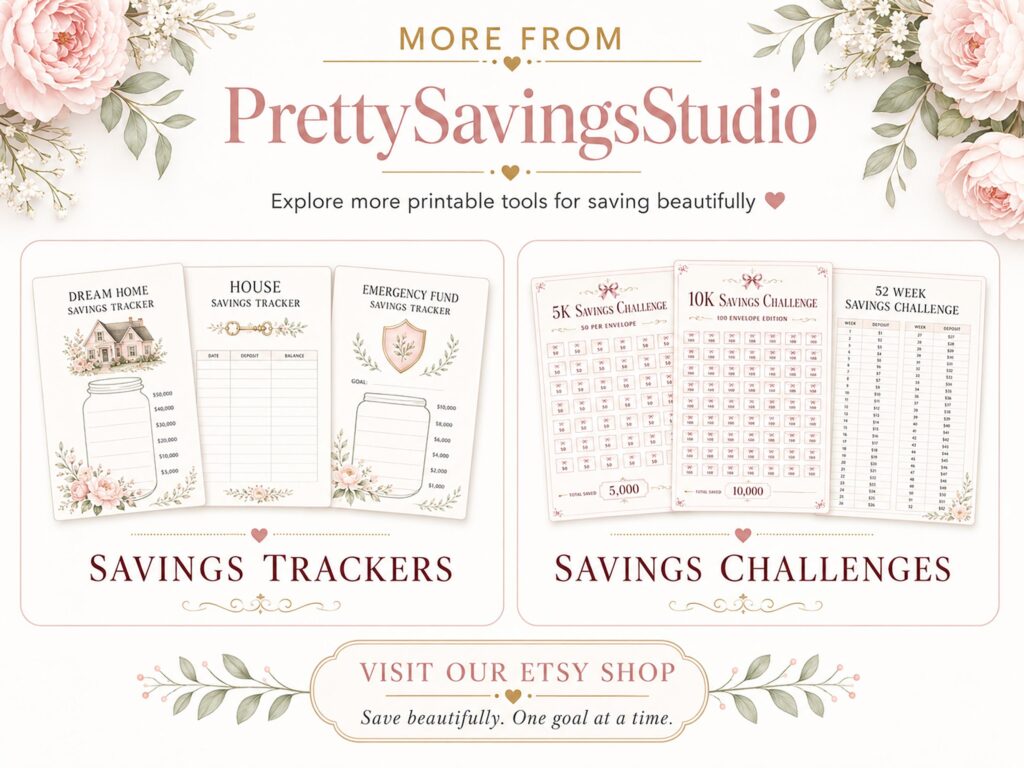
A printable savings tracker, savings planner, or money saving challenge can help you turn those choices into visible progress and stay focused on what you are saving for.
Explore our savings trackers and savings challenges and choose a simple tool for your next savings goal:
Pretty Savings Studio
Pretty tools for your more beautiful and organized life: