Description
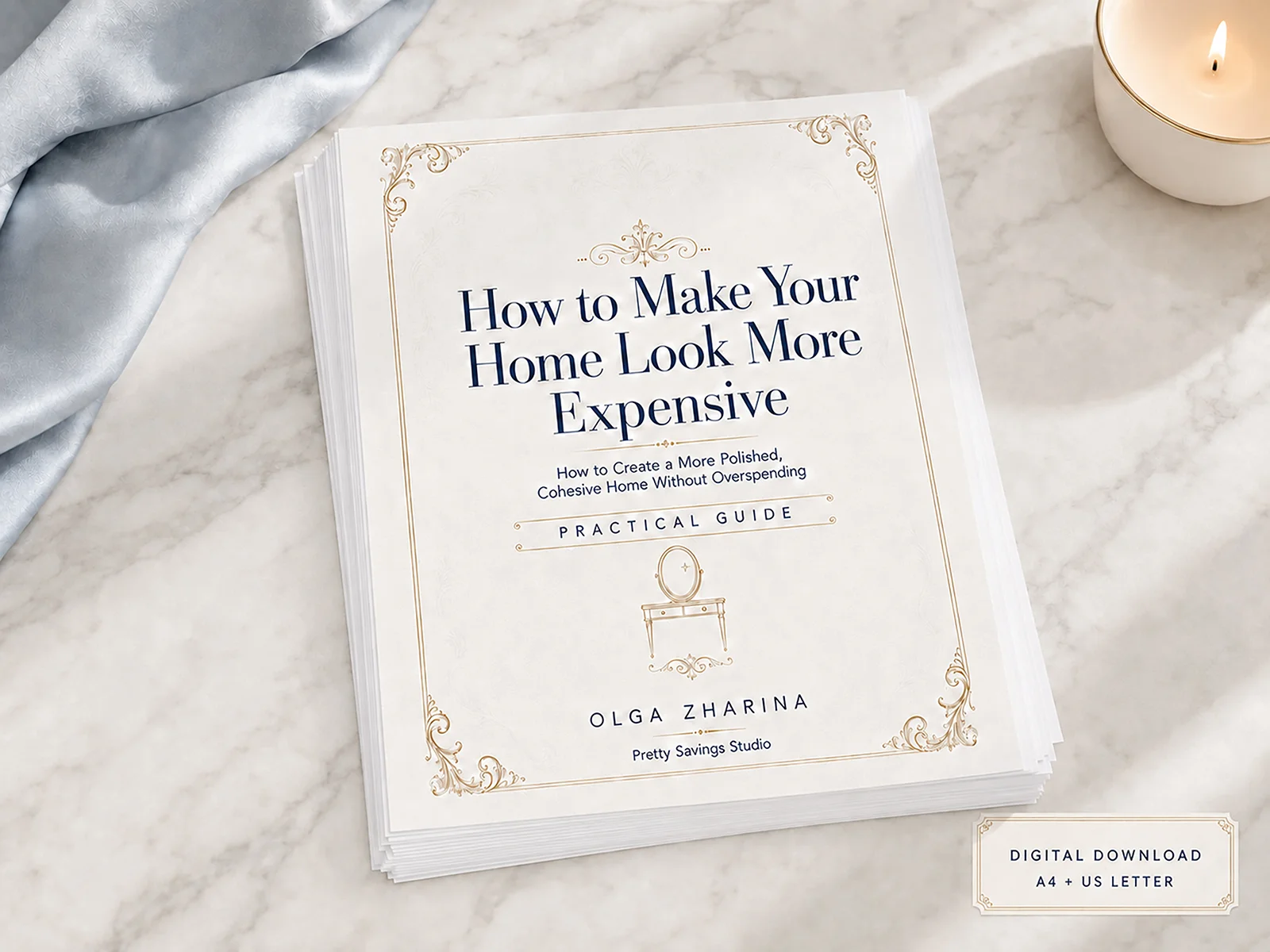
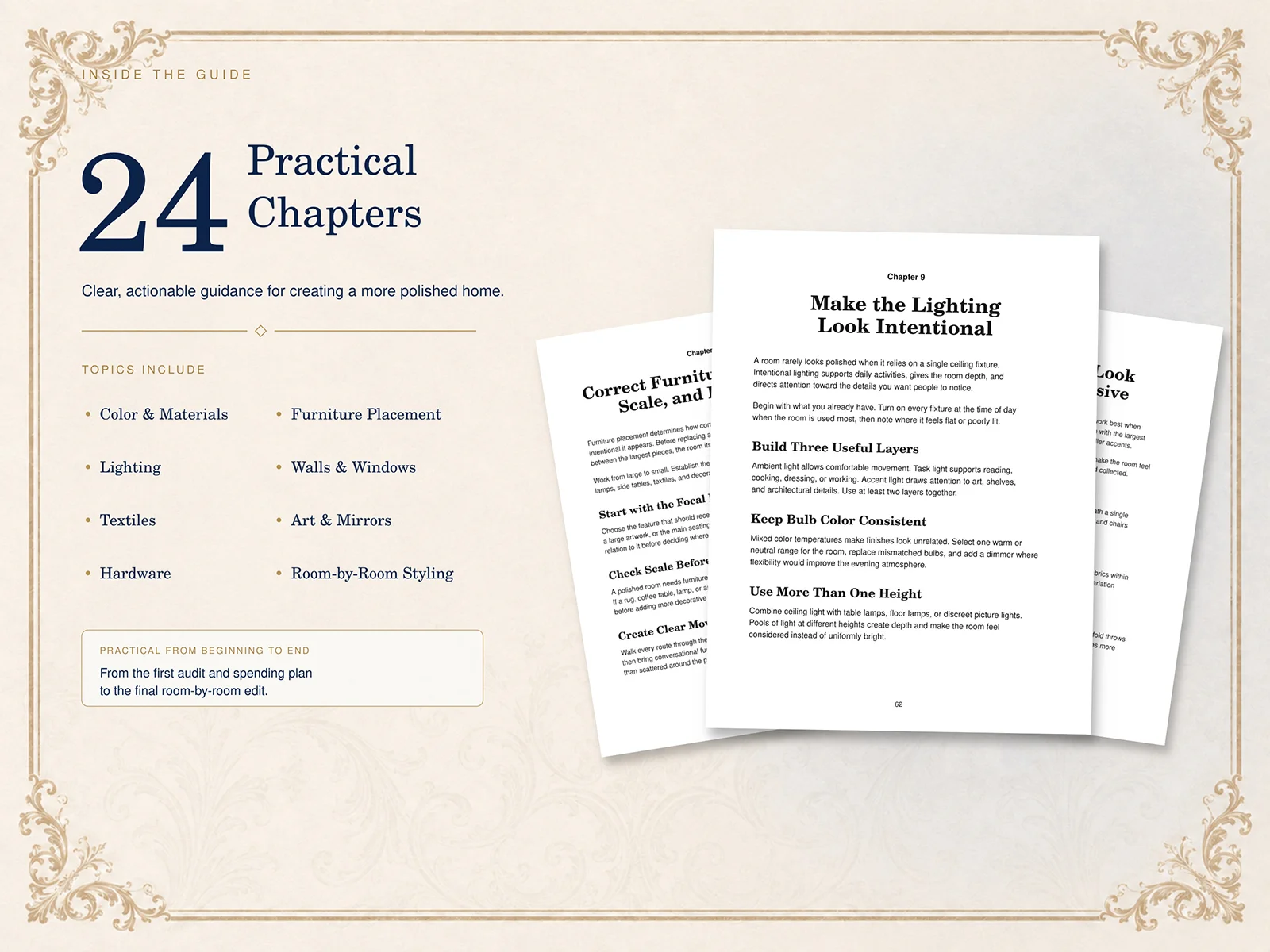
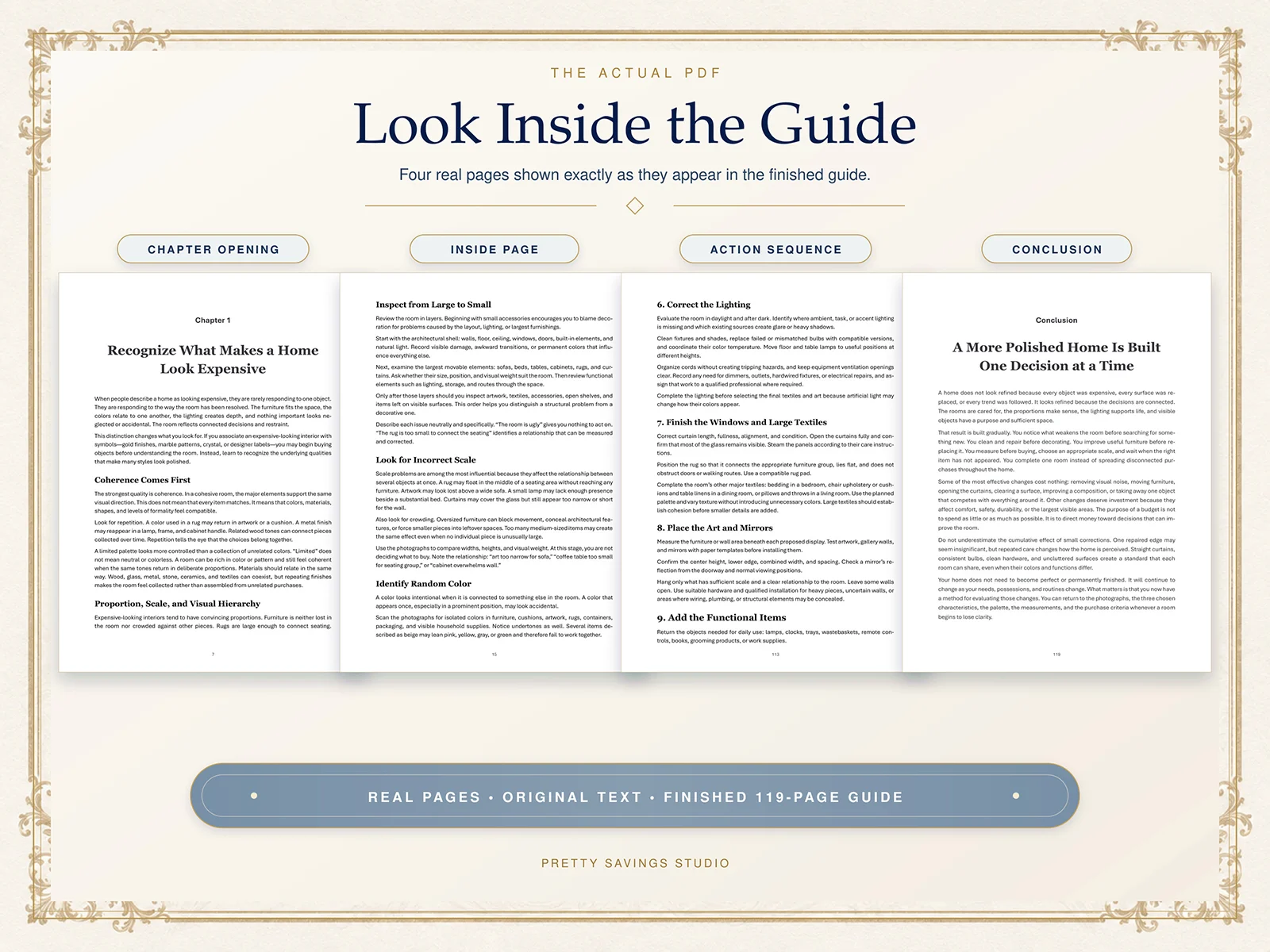
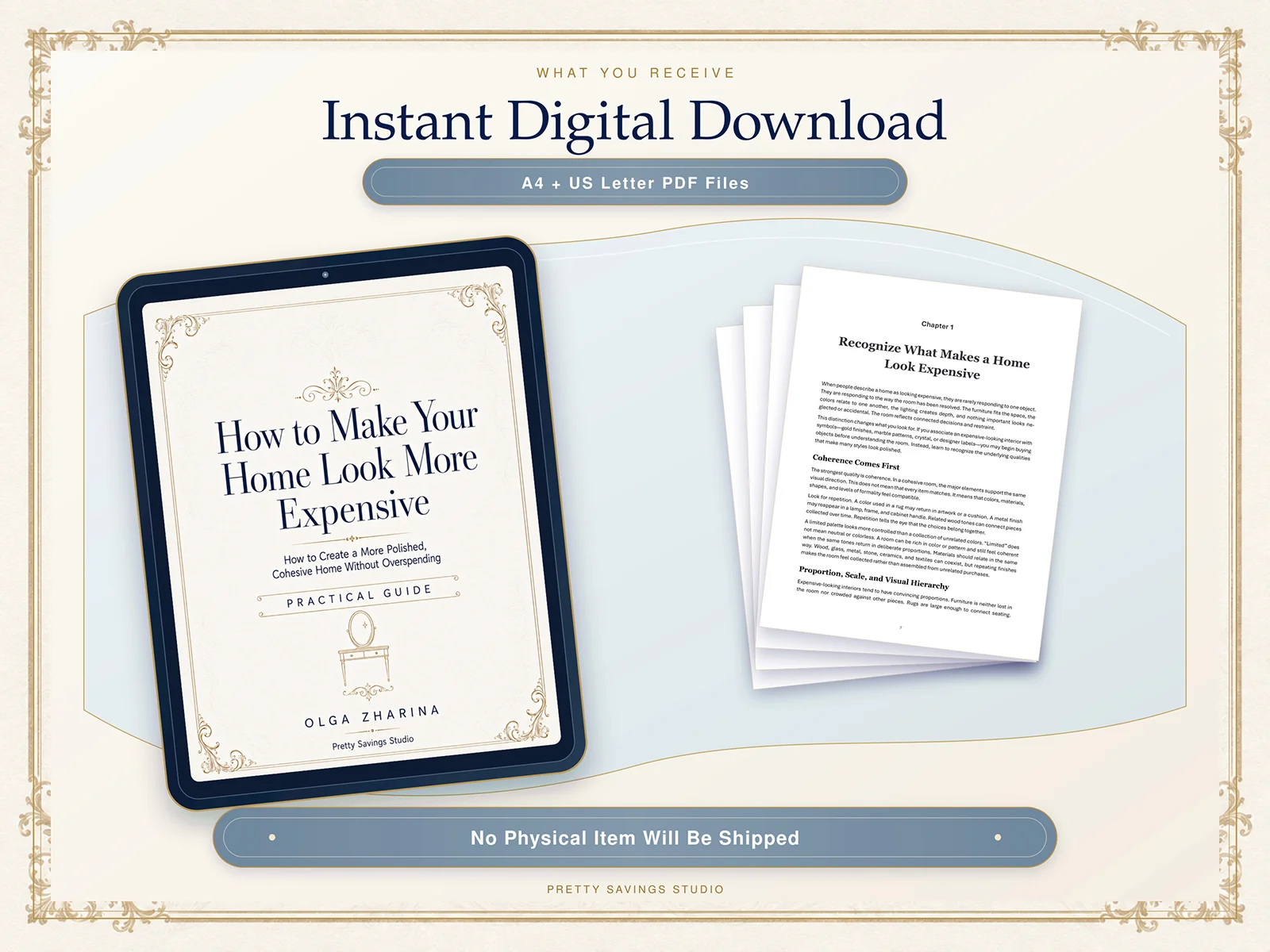
Create a more polished, cohesive, and expensive-looking home without a major renovation or an unlimited decorating budget with How to Make Your Home Look More Expensive, a practical 119-page home decorating book filled with realistic interior design strategies you can apply one room at a time.
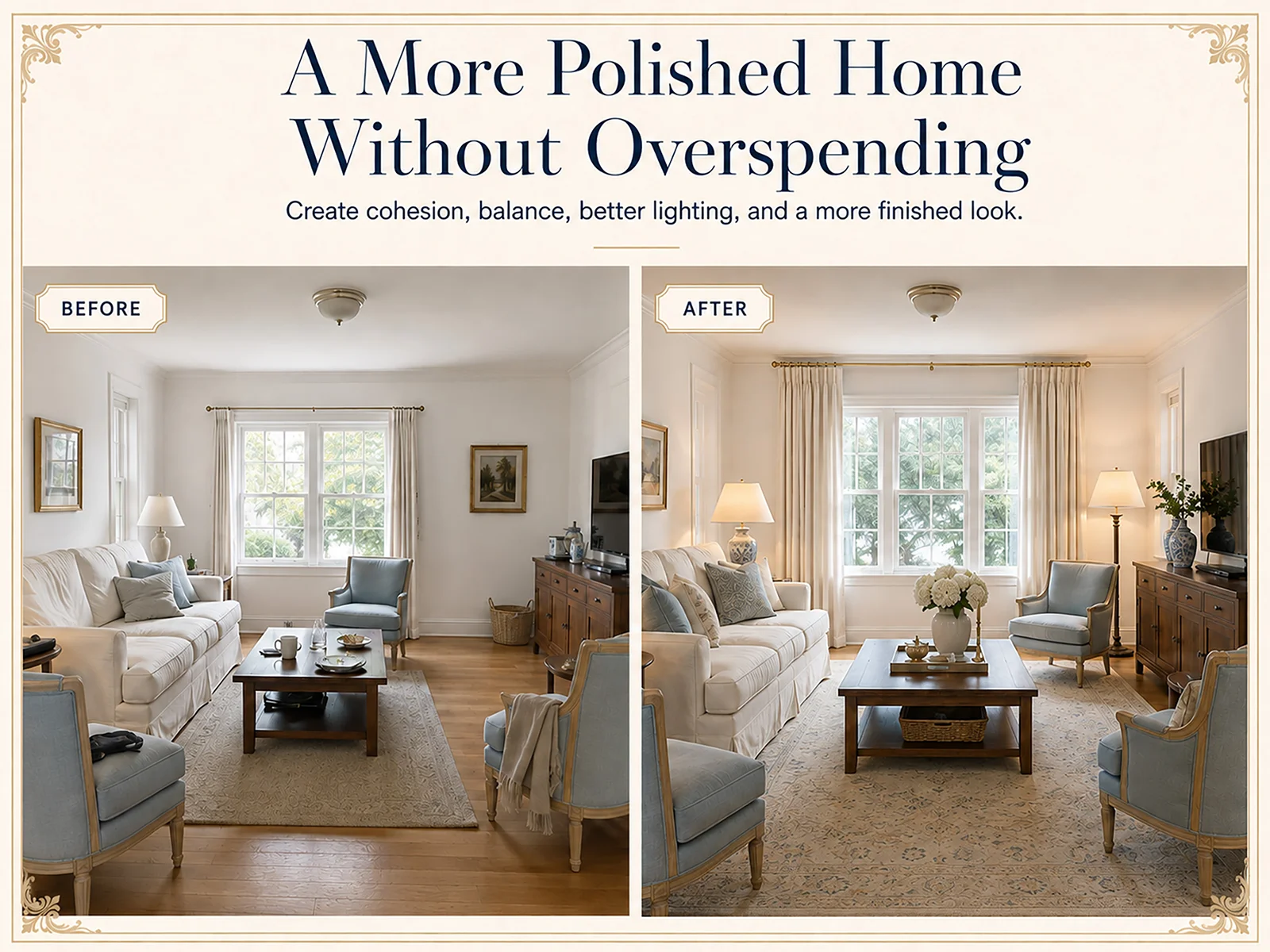
Instead of telling you to replace everything you own or fill your home with expensive decorative objects, this book shows you how to identify what is weakening a room, improve the pieces you already have, correct the most visible problems, and spend money only where it will make a meaningful difference.
The goal is not to make your home look flashy.
It is to create an interior that feels intentional, balanced, well maintained, cohesive, comfortable, and beautifully finished.
119 PAGES • 24 PRACTICAL CHAPTERS • 5 PARTS
How to Make Your Home Look More Expensive is a practical home decor and interior design book rather than a collection of aspirational rooms to copy.
It gives you a step-by-step method for improving:
• Color and materials
• Furniture placement
• Scale and proportion
• Lighting
• Walls and floors
• Windows and curtains
• Furniture and textiles
• Art and mirrors
• Hardware and fixtures
• Surface styling
• Organization
• Room-by-room decorating
• Budget priorities
• Final editing and maintenance
The method is designed to help you make better decorating decisions before you spend more money.
WHAT THIS HOME DECORATING BOOK HELPS YOU DO
You will learn how to:
• Recognize what makes a home look polished and expensive
• Define a clear direction for your interior
• Evaluate each room objectively
• Identify the problems that have the greatest visual impact
• Create a cohesive color and material palette
• Reduce clutter and visual noise
• Improve cleanliness and visible maintenance
• Correct furniture placement
• Improve scale and proportion
• Create more intentional lighting
• Upgrade walls, floors, windows, doors, and visible finishes
• Improve existing furniture rather than automatically replacing it
• Use rugs, curtains, bedding, pillows, and other textiles effectively
• Choose art and mirrors more carefully
• Improve hardware and small fixtures
• Style surfaces without filling them with clutter
• Transform your home one room at a time
• Decide where spending more makes sense
• Identify areas where you can save
• Create a realistic decorating budget
• Complete a final edit before buying anything else
• Maintain the finished result over time
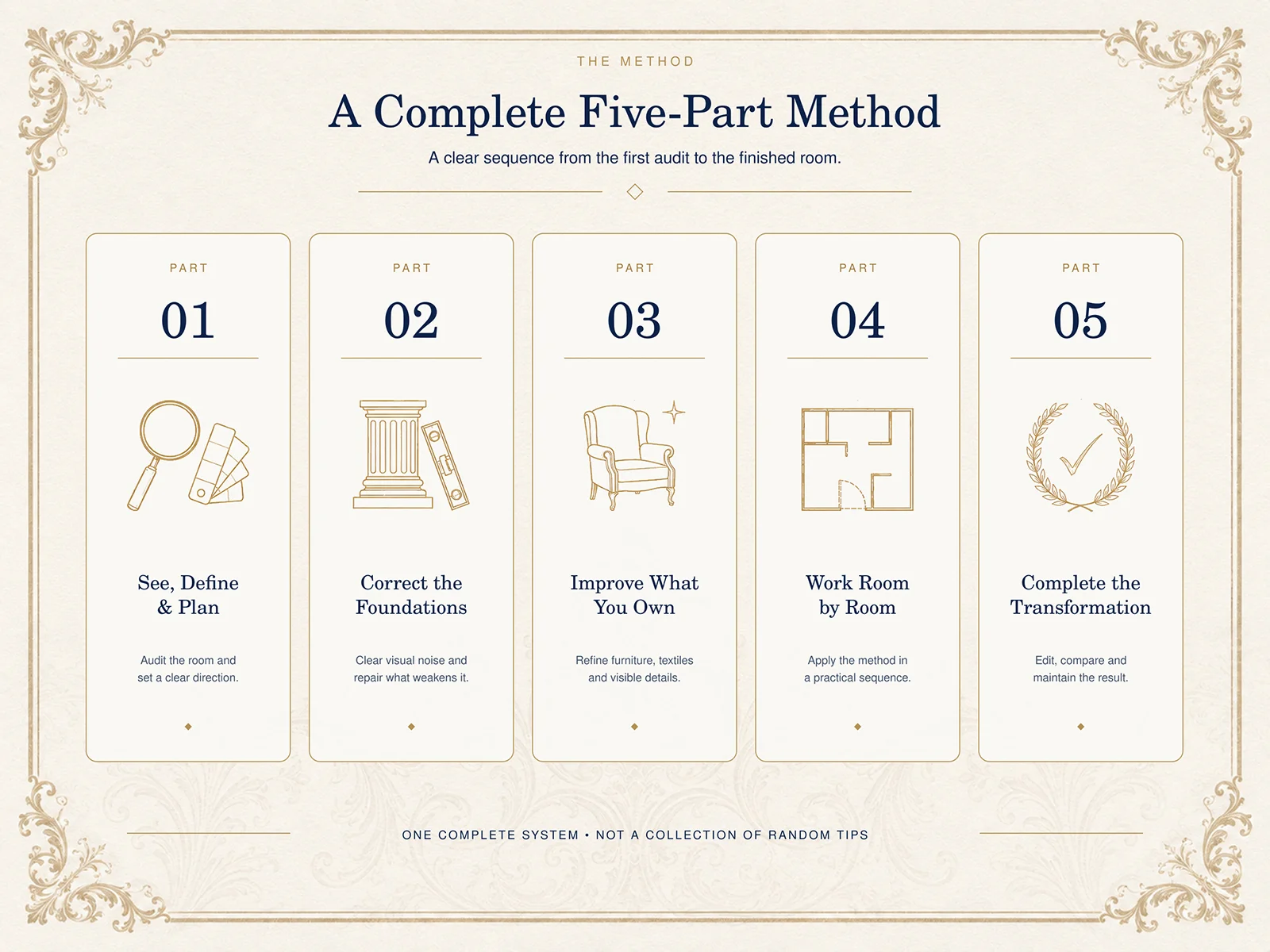
PART ONE — SEE, DEFINE, AND PLAN
Before buying new decor, learn to see your home more clearly.
This part helps you identify why certain interiors feel refined while others feel unfinished, even when both contain attractive furniture and decorative objects.
You will learn how to:
• Define the atmosphere you want
• Audit your existing rooms
• Identify visual weaknesses
• Establish a color direction
• Coordinate materials
• Decide which problems deserve attention first
• Set decorating priorities before spending money
Creating a clear direction at the beginning can prevent expensive mistakes later.
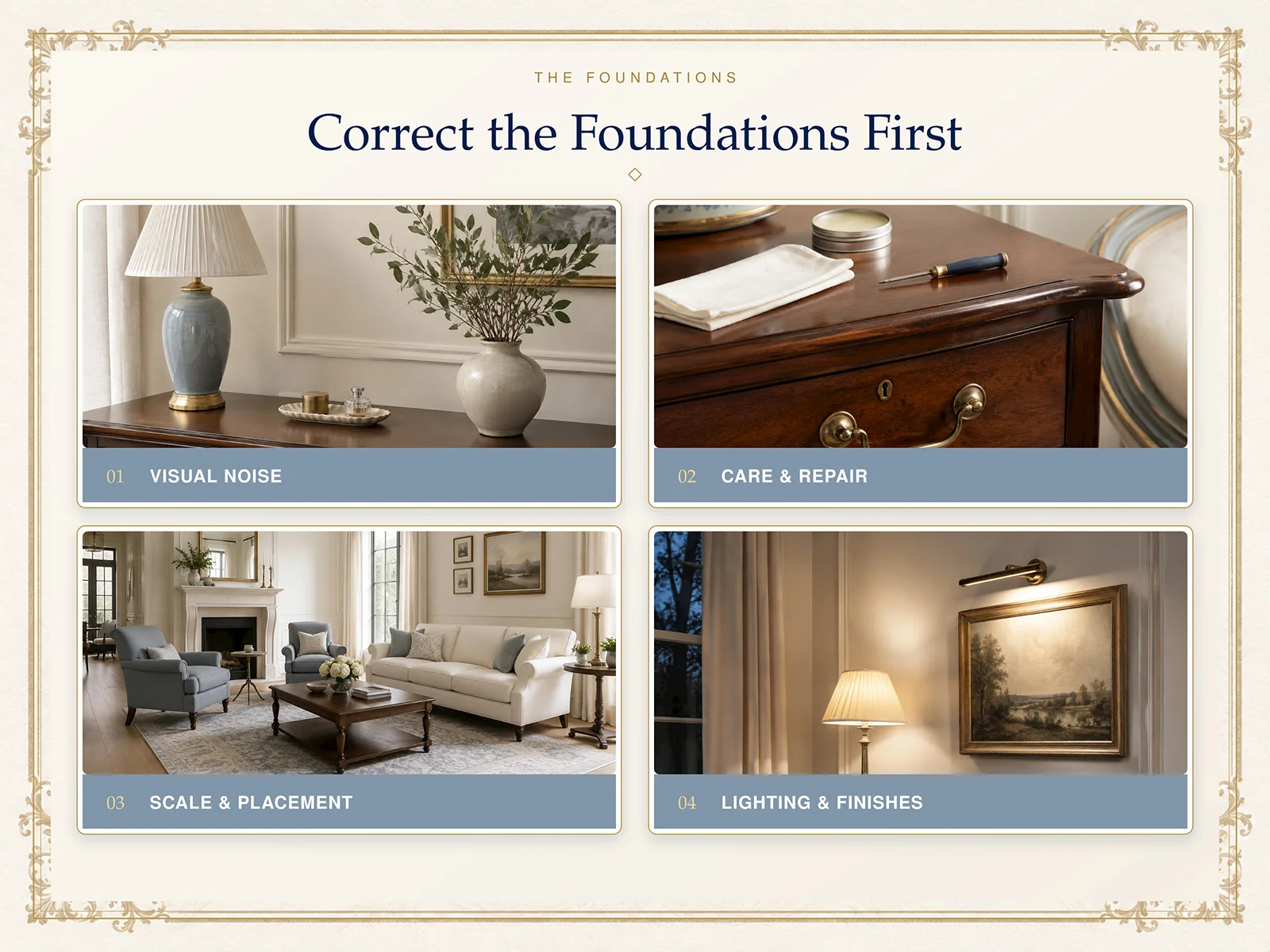
PART TWO — CORRECT THE FOUNDATIONS
Many rooms do not need more decoration. They need their foundations corrected.
This section focuses on high-impact improvements such as:
• Removing visual noise
• Controlling clutter
• Repairing visible wear
• Improving cleanliness
• Rearranging furniture
• Correcting scale and proportion
• Improving lighting
• Refining walls and floors
• Improving windows and curtains
• Strengthening architectural lines
• Correcting distracting finishes
These changes can often transform the way a room feels before anything new is purchased.
PART THREE — IMPROVE WHAT YOU ALREADY OWN
An expensive-looking home does not require replacing everything.
One of the central principles of the book is:
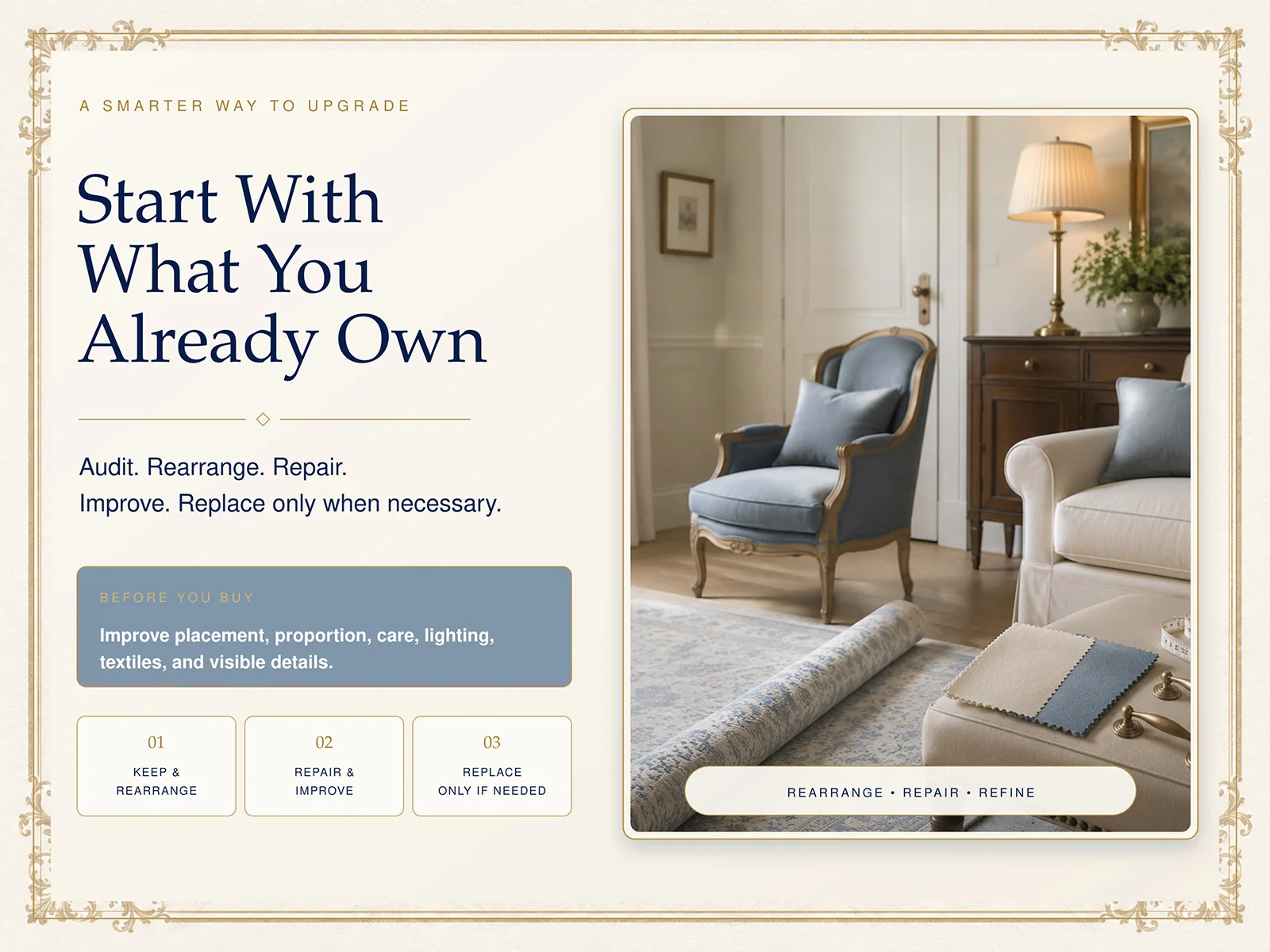
Audit. Clear. Clean. Repair. Rearrange. Improve. Replace only when necessary.
You will learn how to evaluate existing:
• Furniture
• Rugs
• Curtains
• Bedding
• Pillows
• Textiles
• Art
• Mirrors
• Hardware
• Lighting
• Accessories
• Decorative objects
Sometimes the problem is not the item itself. It may be its placement, scale, condition, color, surrounding clutter, or relationship with the rest of the room.
HOW TO MAKE YOUR HOME LOOK MORE EXPENSIVE
An expensive-looking interior is rarely created by displaying as many “luxury” objects as possible.
The book focuses instead on qualities that make a home appear more considered and refined:
• Visual order
• Consistent colors and materials
• Appropriate furniture scale
• Good proportions
• Layered lighting
• Better-maintained finishes
• Thoughtfully hung curtains
• Carefully chosen textiles
• Appropriate art scale
• Less surface clutter
• Better-quality details where they matter
• Repetition and continuity between rooms
• A strong final edit
Small corrections can often have more visual impact than another shopping trip.
CREATE A COHESIVE COLOR AND MATERIAL PALETTE
Rooms can look unfinished when colors, woods, metals, textiles, and finishes feel disconnected.
You will learn how to create a clearer visual direction and use repetition to connect different elements of your home.
The goal is not to make every room identical, but to make your choices feel related and intentional.
IMPROVE FURNITURE PLACEMENT AND SCALE
Even attractive furniture can make a room look awkward when it is the wrong size or positioned poorly.
The book helps you evaluate:
• Furniture placement
• Conversation areas
• Walking paths
• Scale
• Proportion
• Balance
• Visual weight
• Relationships between individual pieces
Before replacing furniture, you will learn how to test whether rearranging what you already own can solve the problem.
USE LIGHTING TO MAKE YOUR HOME FEEL MORE FINISHED
Lighting is one of the most influential elements of an interior.
Instead of relying only on a single ceiling light, you will learn how to create layers of illumination using appropriate combinations of:
• Ceiling lighting
• Floor lamps
• Table lamps
• Wall lighting
• Task lighting
• Accent lighting
Better lighting can make colors, furniture, art, and materials look more flattering while creating a warmer and more comfortable atmosphere.
UPGRADE WALLS, FLOORS, WINDOWS, AND FINISHES
Large visible surfaces strongly affect how polished a home feels.
The book explains how to evaluate and improve:
• Walls
• Paint
• Flooring
• Baseboards
• Doors
• Windows
• Curtains
• Hardware
• Other visible finishes
Some improvements may require spending money, while others depend mainly on maintenance, proportion, placement, or removing distracting details.
USE TEXTILES MORE EFFECTIVELY
Textiles can add softness, depth, comfort, and visual richness.
You will explore how to make better choices with:
• Rugs
• Curtains
• Bedding
• Pillows
• Throws
• Upholstery
Instead of automatically adding more layers, the focus is on choosing the right scale, quantity, texture, and placement.
CHOOSE ART, MIRRORS, AND DECOR MORE CAREFULLY
Decorative objects should support a room rather than overwhelm it.
You will learn how to think about:
• Art scale
• Art placement
• Gallery walls
• Mirror placement
• Decorative groupings
• Surface styling
• Negative space
• Repetition
• Editing
The result is a home that feels styled without looking crowded.
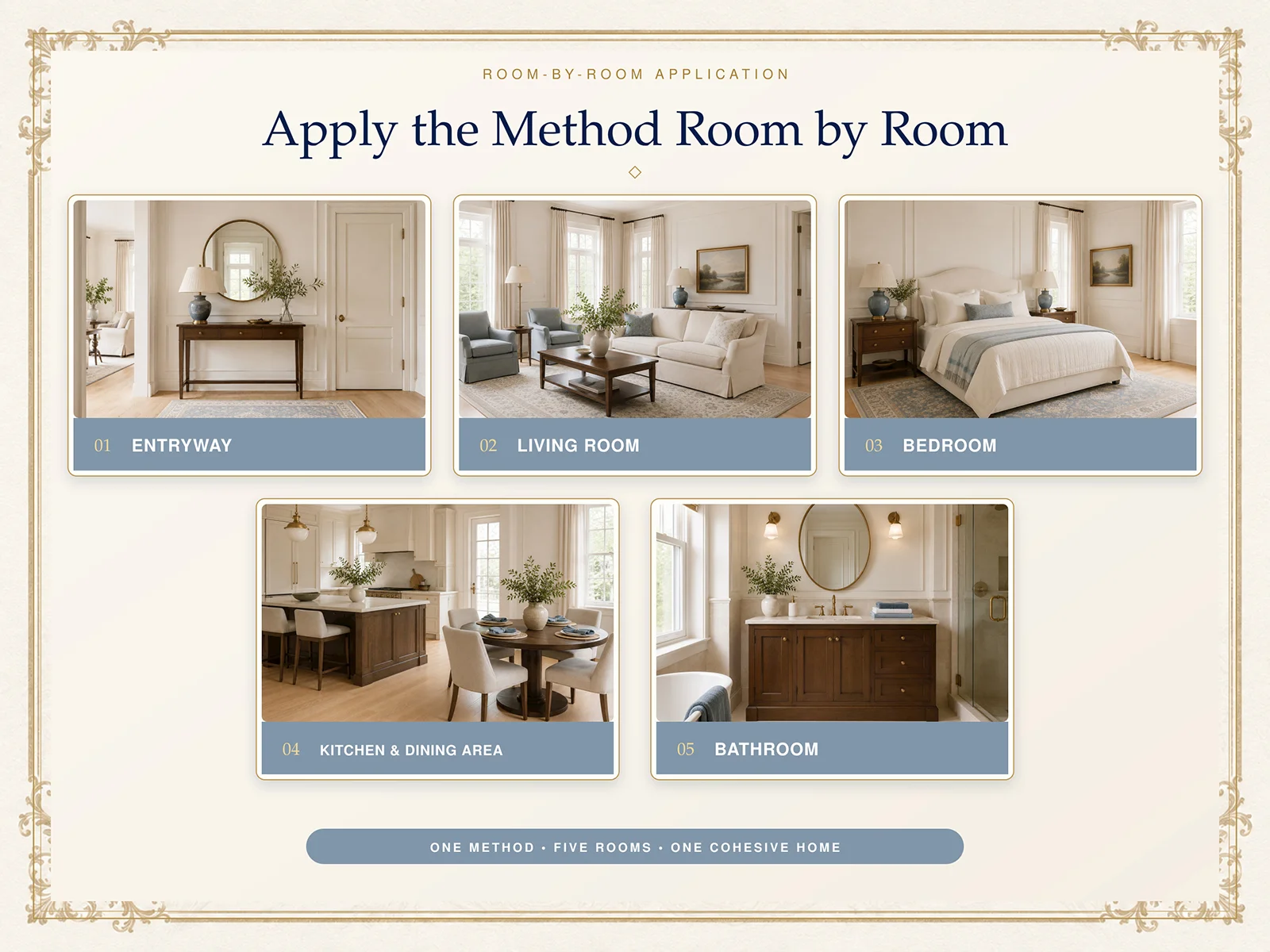
PART FOUR — APPLY THE METHOD ROOM BY ROOM
The book then applies the principles to the major areas of the home.
You will find practical transformation sequences for the:
• Entryway
• Living room
• Bedroom
• Kitchen
• Dining area
• Bathroom
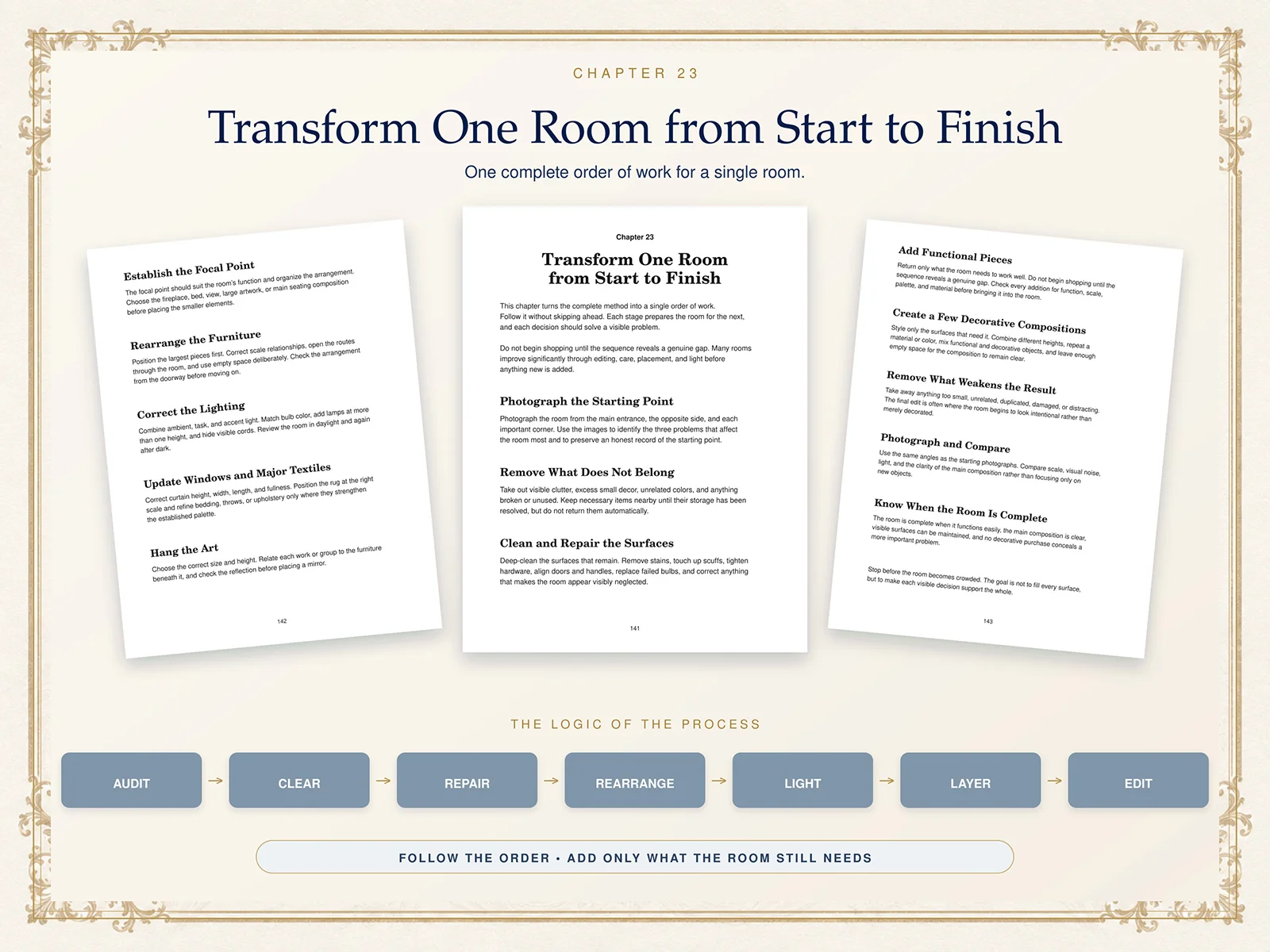
Each room is approached in a logical order so that fundamental problems are corrected before decorative details are added.
ENTRYWAY
Learn how to create a more polished first impression through better organization, lighting, storage, scale, and carefully chosen details.
LIVING ROOM
Evaluate furniture layout, rugs, lighting, textiles, art, surfaces, and focal points to create a room that feels more balanced and complete.
BEDROOM
Use bedding, lighting, furniture placement, textiles, organization, and visual restraint to create a calmer and more luxurious-feeling space.
KITCHEN AND DINING AREA
Improve visible surfaces, lighting, hardware, organization, dining furniture, and everyday details without assuming that a complete kitchen renovation is necessary.
BATHROOM
Create a cleaner, calmer, more hotel-inspired bathroom through maintenance, organization, lighting, textiles, hardware, and selective decorative choices.
PART FIVE — COMPLETE THE TRANSFORMATION
Once the major improvements are finished, the final step is editing.
You will learn how to:
• Review the room as a whole
• Remove unnecessary items
• Identify anything still missing
• Check visual balance
• Correct weak details
• Make final selective purchases
• Establish simple maintenance routines
The objective is to know when a room is finished instead of continuing to add more.
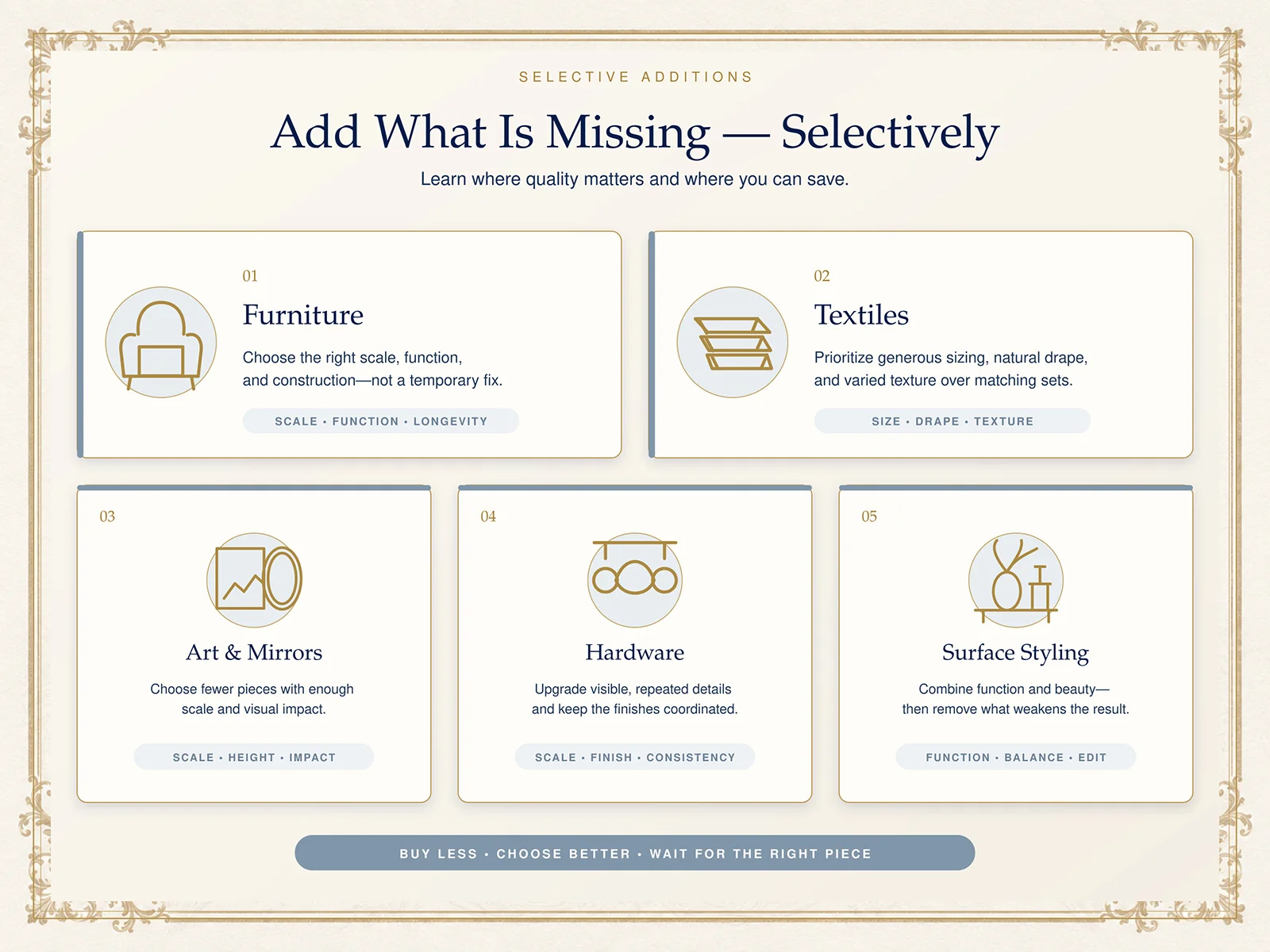
DECORATE ON A REALISTIC BUDGET
Making a home look better does not mean spending equally everywhere.
The book helps you distinguish between:
• Improvements worth investing in
• Items that can be upgraded inexpensively
• Existing pieces that can be reused
• Problems that can be fixed without shopping
• Purchases that can wait
• Changes that create the greatest visual impact
This allows you to create a more refined home gradually rather than treating decorating as one large expense.
START WITH WHAT YOU ALREADY HAVE
Before adding anything new, work through this sequence:
Audit → Clear → Clean → Repair → Rearrange → Improve → Replace only when necessary
You may discover that some of the most effective changes involve:
• Moving furniture
• Removing excess decor
• Clearing visible surfaces
• Steaming or rehanging curtains
• Correcting art placement
• Improving lighting
• Repairing visible damage
• Simplifying decorative arrangements
• Reusing pieces in different rooms
The purpose is to spend strategically rather than automatically.
WHO THIS BOOK IS FOR
How to Make Your Home Look More Expensive may be useful for:
• Homeowners who want a more polished interior
• Renters looking for realistic improvements
• Anyone planning an affordable room makeover
• People whose home feels unfinished
• Anyone struggling with visual clutter
• People interested in elevated home decor
• Anyone decorating on a budget
• People who want to shop for their home more intentionally
• Anyone who wants a cohesive interior without following one specific decorating style
The principles can be adapted to different homes, budgets, lifestyles, and personal styles.
A PRACTICAL INTERIOR DESIGN BOOK
This is not a prescription for one particular aesthetic.
Instead, it helps you understand the underlying decisions that influence how polished a home feels.
You can apply the method whether your style is:
• Modern
• Traditional
• Minimalist
• Contemporary
• Romantic
• Vintage
• Classic
• Eclectic
• Or a combination of styles
The aim is to make your own home feel more intentional — not to make it look exactly like someone else’s.
HOW TO USE THE BOOK
For the most practical approach:
- Read the planning section and audit your home.
- Define the atmosphere, palette, and level of formality you want.
- Select one room as your starting point.
- Correct the foundations before shopping for decor.
- Rearrange and improve what you already own.
- Purchase only the pieces the finished plan shows are missing.
- Complete a final edit before moving to another room.
Working one room at a time can make a larger home transformation easier to manage financially and practically.
WHAT YOU WILL RECEIVE
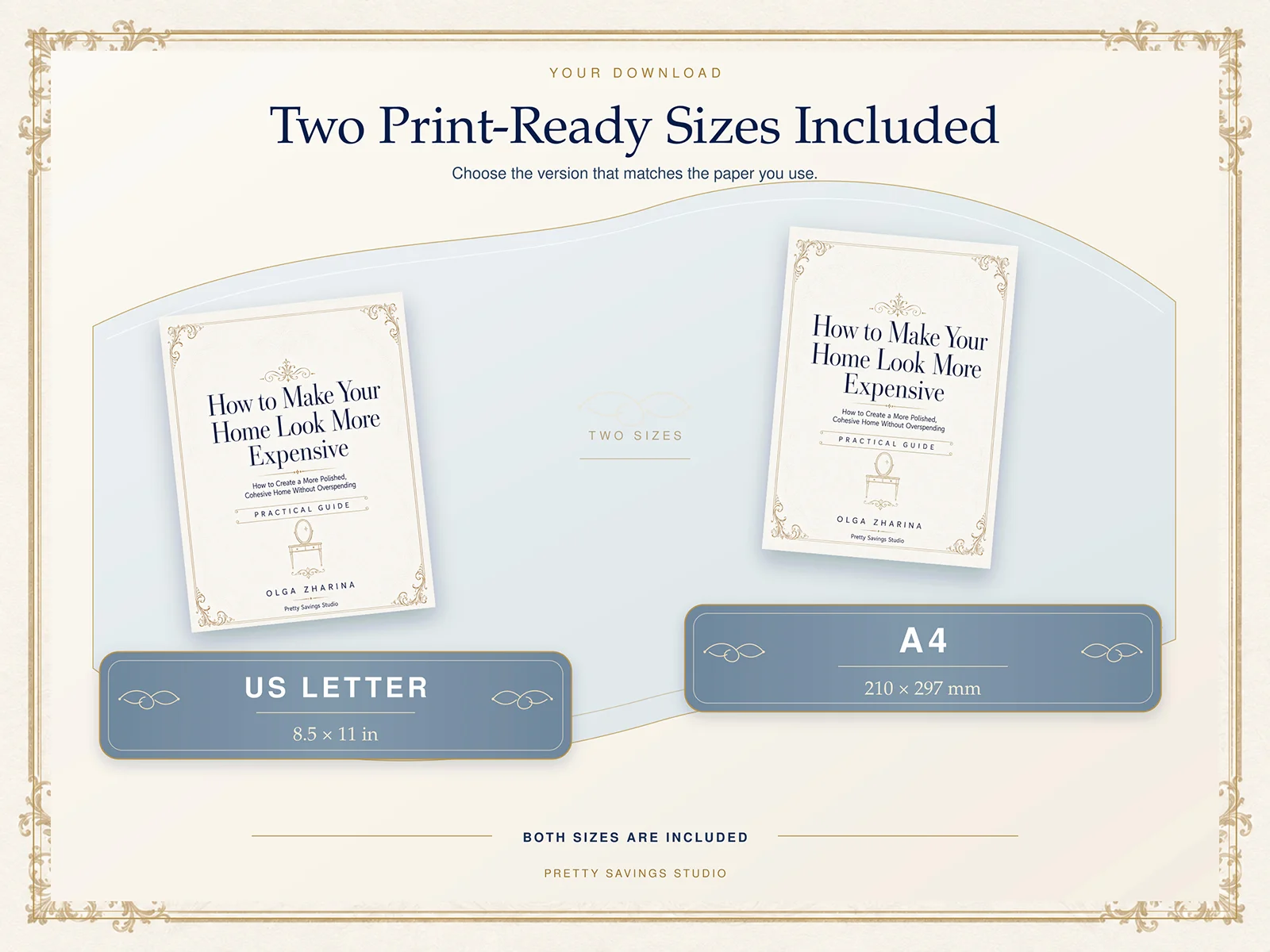
You will receive the complete How to Make Your Home Look More Expensive digital book in two PDF sizes:
• US Letter — 8.5 × 11 in — 119 pages
• A4 — 210 × 297 mm
Both versions contain the complete book with 24 practical chapters.
The files can be read digitally on a tablet, laptop, or computer, or printed for personal use.
DIGITAL DOWNLOAD
This is a digital product.
No physical book, printed item, furniture, tablet, or decorative products will be shipped.
The book is written in English and supplied as non-editable PDF files.
IMPORTANT INFORMATION
This product provides general interior decorating and home styling information. It does not include personalized interior design services.
Printed colors may vary depending on your monitor, printer, ink, paper, and print settings.
PERSONAL USE
This digital book is for personal use only.
You may save the files to your own devices and print copies for personal use, but the files or their contents may not be resold, shared, reproduced, redistributed, uploaded for others, or used commercially.
A more expensive-looking home does not begin with buying more.
It begins with seeing your rooms more clearly, correcting what weakens them, improving what you already own, and adding only what the finished space truly needs.
Reviews
There are no reviews yet.